Today marks a key moment for the enterprise AI landscape as Nvidia launched the Open Agent Safety Platform on September 28, 2026. This new release joins existing solutions from Broadcom, Salesforce, and Microsoft in a rapidly evolving market. Choosing the right ai agent governance platform is now critical for safety and compliance. You need a system that protects data while enabling innovation across your stacks.
Market Context and Recent Launches
The competitive environment tightened significantly in the last two weeks of August and early September. Four major governance platforms shipped standalone products within the same narrow window. Broadcom AgentMinder arrived on August 31 at VMware Explore 2026. Shortly after, Microsoft Agent 365 and Salesforce Agentforce 360 solidified their positions. Nvidia joined this group on September 28. This clustering shows vendors recognize the immediate need for control in production environments.
Technical Requirements for Runtime Enforcement
Successful deployment relies on specific infrastructure capabilities. Runtime enforcement requires a cloud-native AI gateway or service mesh that sits between agents and enterprise resources. Hardware-based monitoring like Nvidia Sentry requires BlueField-4 DPUs or equivalent DPU infrastructure. You must also ensure integration with existing identity systems. This binding ensures agent identities match their declared intents and missions. OpenTelemetry support is mandatory for observability and audit trail export.
Implementation Timeline and Steps
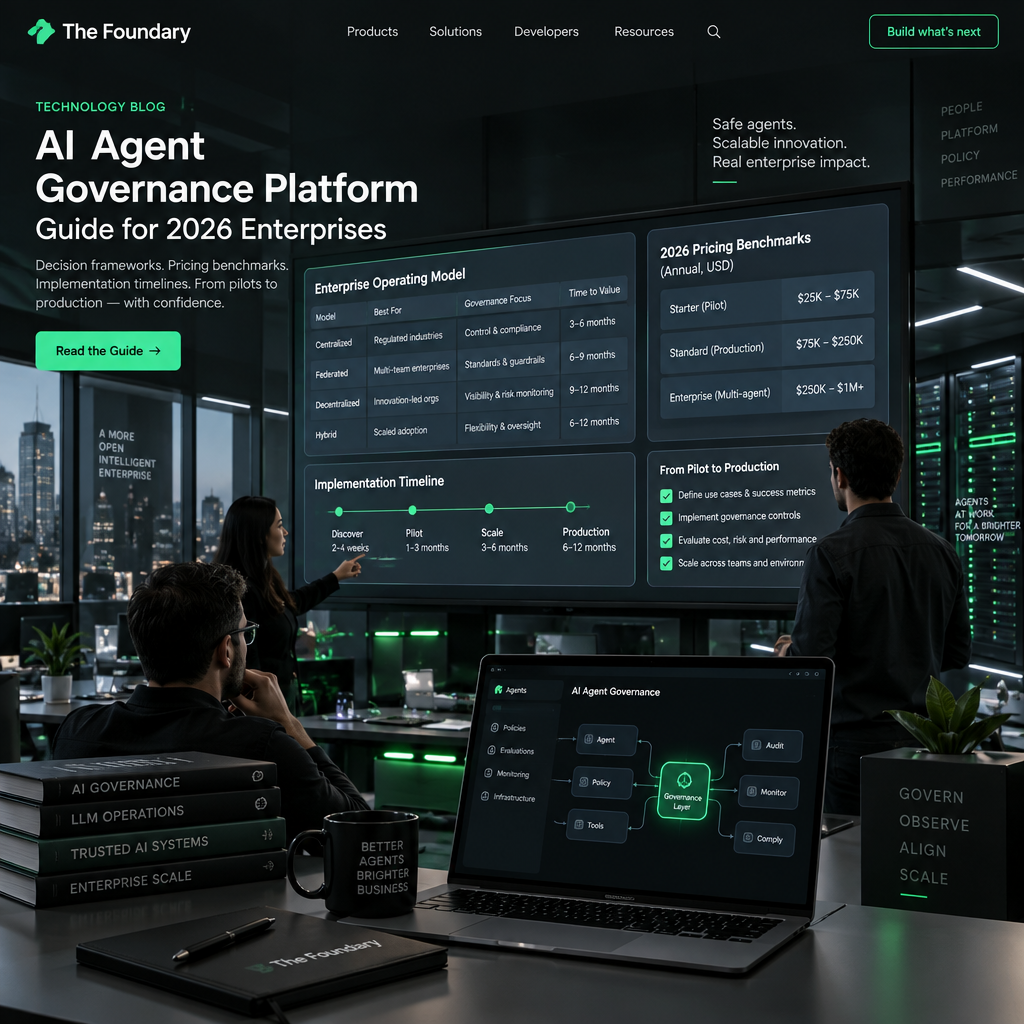
A structured rollout reduces risk during deployment. Follow this roadmap to integrate governance effectively.
- Discovery and Inventory (Weeks 1 to 2): Run agent discovery using OpenTelemetry instrumentation and document all agents in a centralized registry.
- Policy Definition (Weeks 3 to 4): Define least-privilege permissions and write policy-as-code using your platform’s expression language.
- Runtime Enforcement Deployment (Weeks 5 to 8): Deploy the control plane in staging and enable OpenTelemetry-based audit logging.
- Compliance Integration (Weeks 9 to 10): Configure audit trail fields to match strictest applicable framework retention requirements.
- Production Rollout (Weeks 11 to 12): Enable enforcement with human-in-the-loop approval for high-risk actions and schedule quarterly reports.
Pricing Benchmarks and Licensing Models
Costs vary significantly across vendors and deployment models. Per-user licensing models require budgeting for 500 to 5,000 users at $12, $15 per user monthly annually. Microsoft Agent 365 costs $15 per user per month when paid yearly. IBM watsonx.governance offers a free Lite tier, but Basic starts at $3,500 per month. Enterprise platforms like Arthur AI and Zenity typically require custom pricing. Implementation costs for Salesforce Agentforce deployments typically range from $150,000 to $600,000 in year one.
| Platform | Vendor | Pricing Model | Key Capabilities |
|---|---|---|---|
| Broadcom AgentMinder | Broadcom | Contact sales | Runtime enforcement, AuthZEN integration |
| Microsoft Agent 365 | Microsoft | $15/user/month | Entra Agent ID, Purview integration |
| IBM watsonx.governance | IBM | Free Lite to $42,000+ | Model management, compliance mapping |
| Arthur AI | Arthur | Free to Custom | Mixed-cloud discovery and policy |
| Salesforce Agentforce | Salesforce | Per action or $125, $550/user | Einstein Trust Layer, Data Cloud grounding |
Evaluating Your ai agent Governance Platform
Selecting a vendor depends on your operating model and existing stack. If you operate in a Microsoft-centered estate, Agent 365 integrates smoothly with Entra and Purview. For regulated inventories, IBM watsonx.governance offers reliable model management. Organizations seeking full-stack governance with hardware enforcement might look to Nvidia. The ai agent governance platform must handle specific constraints such as hardware watchdogs or cloud-native gateways. Ensure the solution supports your required identity standards like AuthZEN or Entra ID.
Compliance and Audit Trail Requirements
Regulatory frameworks dictate minimum retention periods. The EU AI Act Article 12 requires high-risk AI systems to record events over the system lifetime with a minimum six-month retention. SOX-relevant systems require 366 days of operational logs and seven years of audit work papers. HIPAA requires six years of PHI access logs. You must configure tamper-evident, append-only storage with cryptographic integrity verification to meet these demands. Audit trails should include timestamp, decision ID, human identity, model version, and downstream actions.
Build versus Buy Decisions
Deciding to build or buy affects long-term costs. Building a custom control plane using OpenTelemetry and Kubernetes requires 6 to 12 months engineering effort at 4 to 8 FTEs. The implementation cost ranges from $500,000 to $2 million. Buying enterprise platforms typically requires $50,000 to $250,000 annually plus implementation fees. Microsoft Agent 365 at $15 per user is most predictable for M365-heavy estates. Early deployments show payback through reduced security incident response time and audit preparation effort. Full ROI requires mature agent fleets with measurable business outcomes.
Security Considerations for Control Planes
Security policies must enforce boundaries at runtime. Agents must be quarantined if they violate intent-based policies. This enforcement happens within milliseconds using specialized hardware like BlueField-4 DPUs. Your team needs identity and access management expertise for binding agent identities. Cloud-native Kubernetes deployment skills are also essential for control plane installation. Policy-as-code authoring ensures consistency across your environment. We help teams build these foundations at The Foundary. Always ensure you review our Privacy Policy when sharing enterprise data.
Talk to a counsellor
Start a conversation with The Foundary to discuss your platform architecture. We help engineering teams evaluate options and deploy governance controls. Let us assist with your AI infrastructure.
Conclusion
Navigating the 2026 market requires clear criteria for vendor selection and deployment. Focus on your existing stack and compliance needs to guide your choice. Investing in an ai agent governance platform is essential for secure scaling.
Frequently Asked Questions!
1. Does OpenShell require Nvidia hardware or can it run on Arm Intel systems?
OpenShell is an open-source secure runtime that sets boundaries for agents. While Nvidia Sentry hardware monitoring requires BlueField-4 DPUs, the runtime itself is flexible.
2. What is the typical latency impact of running a runtime enforcement gateway in front of agents?
Public benchmarks comparing runtime enforcement overhead across platforms are limited. Vendors claim millisecond-level quarantine capabilities on specialized hardware.
3. How do I migrate existing agent deployments built on LangChain to a governed control plane?
Migrate by defining least-privilege permissions and configuring identity binding in Phase 2. Use the control plane to manage traffic in production.
4. What audit trail fields are absolutely required for EU AI Act high-risk systems?
EU AI Act Article 12 requires automatic recording of events over the system lifetime with six-month retention. Logs must include decisions and system state.
5. Are there industry certifications for these governance platforms themselves?
Vendor-specific compliance certifications like SOC 2 Type II are not verified for all platforms. Ask vendors directly for their latest audit reports.
6. What happens when an agent fails a policy check during production?
You can configure the policy to block the action entirely or notify a human for approval in high-risk scenarios.