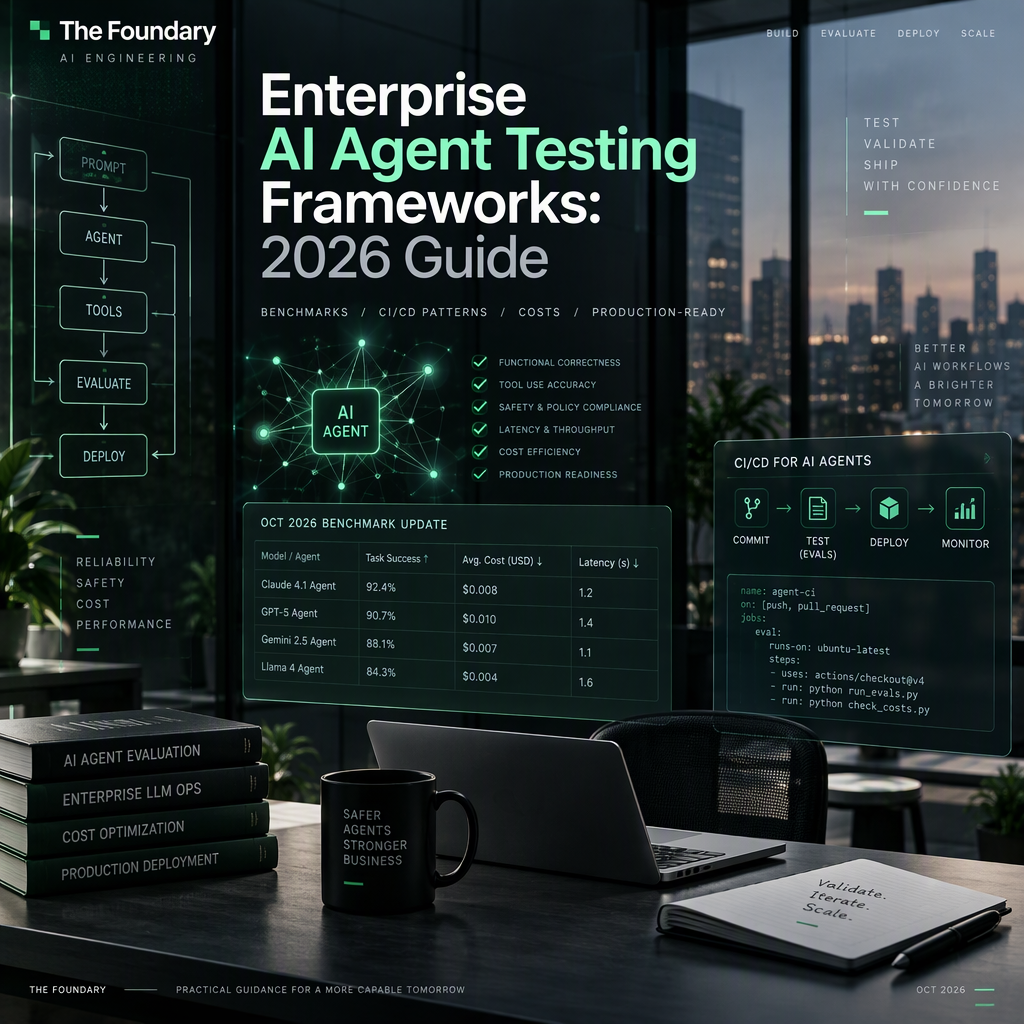
In the rapidly evolving landscape of autonomous systems, enterprise ai agent testing frameworks provide the foundation for reliability. Without rigorous evaluation, agents risk hallucinations and workflow breaks in critical business environments. Recent releases in October 2026 have updated standards significantly for professional workflows. Teams must now adapt their pipelines to meet these new benchmarks while managing costs and compliance. This guide provides a production-readiness roadmap for engineering leaders deploying agent infrastructure.
Key Changes in Agent Benchmarks
The evaluation landscape shifted dramatically in early October 2026. Terminal-Bench 4.0 launched on October 7, 2026, with major recalibration changes. It removed 8 saturated tasks that previously caused high refusal rates. The framework also fixed 19 tasks with revised environments to ensure fairness. Scores are not directly comparable between versions due to protocol changes. AutomationBench updated on October 9, 2026, with an improved evaluation harness and expanded task coverage. Both benchmarks now reflect realistic professional tasks better than prior iterations.
These updates mean you must recalibrate your golden datasets. Using outdated task sets might yield misleading results on agent quality. You should prioritize the new task categories that reflect current business domains. The changes aim to measure true capability rather than memorized responses. Staying current with these benchmarks prevents your team from optimizing for obsolete metrics.
Core Requirements for Implementation
Successful deployment requires a specific technical stack and skilled personnel. Python 3.12+ is standard for most open-source frameworks like DeepEval. You will need OpenTelemetry instrumentation to capture production traces effectively. A CI/CD system such as GitHub Actions is essential for automated evaluation gates. Open-source options like DeepEval offer flexibility under an Apache 2.0 license. Others provide managed solutions with built-in compliance features for regulated environments.
Skills are equally important for your team. Pytest familiarity is important for working with open-source eval frameworks. You must understand OpenTelemetry configuration to collect trace data reliably. YAML and JSON skills are needed for evaluation dataset definitions. Understanding how to calibrate LLM-as-judge scoring is also necessary. These skills ensure your team can execute testing protocols without external dependency.
Compliance prerequisites are non-negotiable for enterprise settings. Human-in-the-loop annotation queues are required for production metrics calibration. SOC 2 and enterprise SSO must be available on Team or Enterprise tiers. Self-hosting options are available if data residency is a strict requirement. Ensure your vendors meet these standards before committing to a platform.
Selecting enterprise ai agent testing frameworks
Choosing the right platform depends on your team size and technical needs. DeepEval is a top choice for engineering teams managing pytest workflows. It is fully open-source and costs nothing for local evaluation. Confident AI offers a managed solution starting at $200 per month. It includes unlimited seats and charges $1 per GB-month for traces. This pricing model suits cross-functional quality governance requirements.
LangSmith integrates specifically with LangChain and LangGraph frameworks. It has a free tier plus a cost of $39 per seat per month. Arize Phoenix provides open-source monitoring with a paid Pro version. Promptfoo focuses on prompt testing and red teaming capabilities. LangWatch supports multi-agent simulations with native CI/CD integration.
You must weigh open-source flexibility against managed convenience. Open-source tools reduce vendor lock-in but increase operational overhead. Managed tools reduce implementation time but come with monthly costs. Evaluate your budget against your team’s capacity for maintenance. The table below compares key features and costs across major options.
| Platform | Open Source | Pricing Model | Best For | CI/CD Integration |
|---|---|---|---|---|
| DeepEval | Yes (Apache 2.0) | Free (self-hosted) | Engineering teams, pytest workflows | Native pytest/CLI |
| Confident AI | No (self-hosting available) | $200/mo starter + $1/GB traces | Cross-functional quality governance | GitHub Actions SDK |
| LangSmith | No | Free tier + $39/seat/mo | LangChain/LangGraph teams | Native LangChain SDK |
| Arize Phoenix | Yes (ELv2) | Free (open-source) + AX Pro from $50/mo | ML/LLM hybrid monitoring | Pytest/Vitest integration |
| Promptfoo | Yes (MIT) | Free (open-source) | Prompt testing and red teaming | CLI + GitHub Actions |
| LangWatch | Yes (Apache 2.0) | Free tier + €29/seat/mo | Multi-agent simulations | CI/CD native support |
CI/CD Agent Gates and Pipelines
Automating evaluation within your software delivery life cycle is critical. CI/CD evaluation pipelines require 5 specific gates to ensure quality. The first gate involves a golden dataset offline eval before code merge. Regression blocks prevent new code from lowering performance scores. Cost gates monitor token and API spend to prevent budget overruns. Shadow evaluation allows testing on production traffic without impacting users.
The final gate is a canary rollout to verify real-world stability. Each gate must be configurable to fit your risk tolerance. DeepEval supports native pytest integration for these workflows. Confident AI provides a GitHub Actions SDK for easier setup. AWS Bedrock AgentCore provides 17 built-in evaluators including programmatic trajectory matchers.
Trajectory evaluation measures tool-call sequence correctness deterministically. This approach avoids the variance often seen with LLM-as-judge scoring. It ensures that agents follow correct logic paths, not just correct outcomes. AWS documents this capability in their evaluation guide from October 2026. Using deterministic checks improves consistency in your automated pipeline.
To learn more about infrastructure foundations, refer to The Foundary, Engineering Digital Foundations. Understanding the underlying stack helps you integrate evaluation tools effectively.
Step by Step Implementation Process
You should follow a structured timeline to integrate evaluation successfully. Week 1 and 2 focus on baseline assessment and setup. Begin by selecting an evaluation framework for your specific use case. Install and configure the evaluation runner in your development environment. Create an initial golden dataset with at least 50 representative test cases. Document your current agent performance to track improvements later.
Week 3 and 4 are for CI/CD integration. Set up an automated evaluation pipeline that triggers on pull requests. Define clear evaluation thresholds such as task completion rates above 85%. Implement regression blocking for critical metrics to catch issues early. Add a cost gate to prevent excessive token or API spend.
Week 5 and 6 cover production monitoring. Integrate trace collection using OpenTelemetry or provider SDKs. Set up production evaluation that runs on live traffic safely. Configure alerting for quality degradation to respond quickly to issues. Implement a trace-to-dataset feedback loop to improve test cases.
Ongoing optimization keeps your system reliable. Review evaluation metrics and failure modes weekly. Update your golden dataset monthly with production edge cases. Quarterly calibration of LLM-as-judge against human annotations ensures scoring remains fair. This cycle ensures continuous improvement of your agent reliability.
Cost Analysis and ROI
Build versus buy decisions impact your budget significantly. Open-source options like DeepEval cost nothing upfront but require expertise. Managed solutions like Confident AI start at $200 per month. LangSmith charges $39 per seat per month for full access. Self-hosted options like Arize Phoenix have infrastructure costs only.
ROI indicators show clear benefits from implementation. CI gate failures prevent 70-80% of production regressions. Production trace evaluation reduces issue detection from hours to minutes. Cost gates prevent 10-15% token spend overruns. These savings justify the investment in proper testing infrastructure.
Consider the total cost of ownership including personnel. Open-source tools require Python and CI expertise. Managed tools offer full platforms for cross-functional teams. Choose a model that fits your organizational maturity. Read our Terms of Use to understand service terms.
| Option | Initial Cost | Monthly Cost | Team Impact |
|---|---|---|---|
| DeepEval (open-source) | $0 | ~$200-500 (LLM API for evals) | Requires Python/CI expertise |
| Confident AI (managed) | $0 (free tier) | $200/mo (Starter) + $1/GB traces | Full platform, cross-functional |
| LangSmith (managed) | $0 (free tier) | $39/seat/mo | LangChain-dependent |
| Self-hosted (Phoenix) | $0 | Infrastructure only | Requires DevOps support |
Metrics and Evaluation Standards
Metrics determine how you judge agent performance effectively. Tool correctness metrics are essential for verifying specific actions. Trajectory evaluation measures the sequence of tools used. Outcome evaluation checks if the final result is correct. You need both types to ensure logical reasoning and factual accuracy.
Open source agent evals provide transparency for custom metrics. You can build custom evaluators using DeepEval or LangSmith. AWS Bedrock offers 17 built-in evaluators for standard tasks. Ensure your metric definitions align with your business goals. Avoid relying solely on accuracy without checking for hallucinations.
Agent benchmark evaluation 2026 standards focus on professional tasks. Terminal-Bench and AutomationBench offer reliable datasets for this purpose. Align your internal metrics with these external benchmarks. This alignment ensures you are measuring against industry standards. Check Confident AI Evaluation Tools Guide for more comparisons.
Compliance and Security Considerations
Security is paramount for enterprise agent workflows. SOC 2 certification is a baseline requirement for most industries. Enterprise SSO must be available for access control. Self-hosting options support data residency requirements in regulated regions. Ensure your vendor maintains these certifications annually.
Human-in-the-loop workflows are necessary for high-risk decisions. Annotation queues allow experts to validate agent outputs. This process reduces liability and improves trust in the system. Document these processes for audit purposes. Keep your policies current with Privacy Policy standards.
Future Proofing Your Strategy
The field evolves rapidly with new tools emerging monthly. The GitHub awesome-harness-engineering repo tracks 246+ open-source harness repositories. This volume shows active development and community support. Stay updated on these resources to maintain flexibility. Avoid over-investing in tools that may not survive long-term.
Enterprise agent evaluation frameworks will continue to mature. Expect more standardization in how tools interact with CI/CD systems. Keep your architecture modular to swap tools as needed. Prioritize interoperability over specific feature sets. This approach ensures you can adapt to new benchmarks easily.
Final planning involves setting a review cycle for your pipeline. Check your evaluation thresholds quarterly against new benchmarks. Ensure your team remains trained on new standards. Regular reviews prevent technical debt from accumulating. This discipline ensures long-term value from your testing investment.
Talk to a Foundry engineer
Start a conversation with The Foundary about your platform or AI project needs. Talk to The Foundary about AI
Conclusion
You now have a clear roadmap for validating agent workflows using the latest 2026 standards. By adopting rigorous benchmarks and CI/CD gates, you reduce the risk of production failures. Ensure your team stays updated on the tools mentioned to maintain long-term reliability. Investing in proper testing today prevents costly errors tomorrow.
Frequently Asked Questions!
1. What is the minimum viable evaluation setup for a team just starting out?
Begin with DeepEval for open-source flexibility. Create a golden dataset of 50+ test cases and run offline evals before code merges. This provides immediate insight without high costs.
2. How do I calibrate LLM-as-judge scores against human judgment?
Use human-in-the-loop annotation queues to label samples periodically. Compare model scores against human labels quarterly to adjust thresholds. This ensures scores remain fair and accurate over time.
3. What evaluation thresholds should I set for CI gates vs production SLOs?
Set CI gates for task completion above 85% and hallucination below 5%. Production SLOs should be stricter. Start with these values and adjust based on your specific business risk tolerance.
4. How do trajectory evaluators differ from outcome evaluators?
Trajectory evaluators check the sequence of tool calls and logic steps. Outcome evaluators check if the final result is correct. Both are needed to ensure reasoning and factual accuracy.
5. Can I run evaluations with local models to reduce costs?
Yes, open-source frameworks like DeepEval support local models like Ollama. This reduces API costs for internal testing. It is useful for early development stages before production deployment.
6. What metrics matter most for enterprise-grade agent reliability?
Focus on task completion rates, hallucination rates, and tool correctness. Trace duration and token cost are also critical for operational stability. Prioritize these based on your specific application needs.
7. How do I handle multi-turn and voice agent evaluations?
Use frameworks that support multi-turn contexts like LangSmith. Ensure your datasets include complex conversational scenarios. Voice agents require additional latency and clarity metrics beyond standard text.
By the Foundry Engineering Team · Updated 2026-10-12