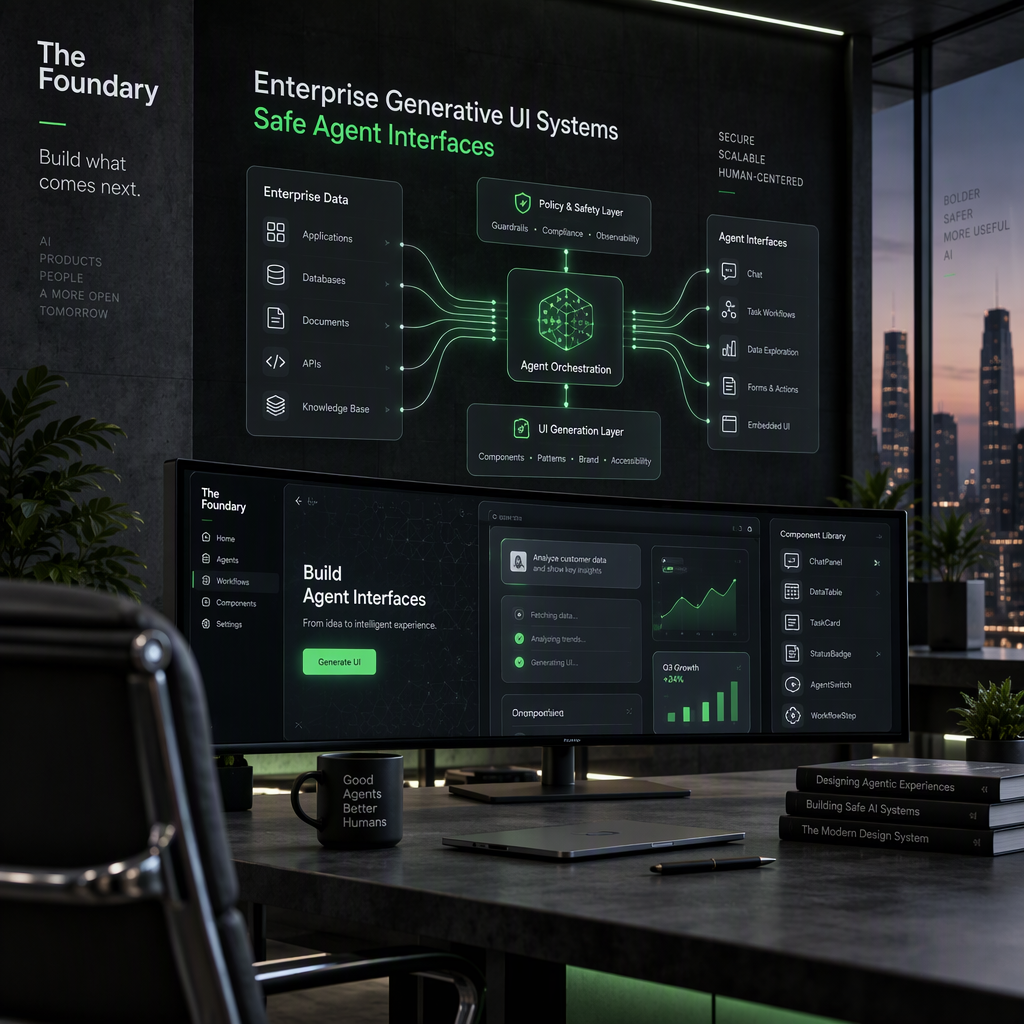
The enterprise generative ui systems landscape shifted on September 30, 2026. Major tools like CopilotKit and OpenUI now target multi-framework parity. You must design interfaces that support agentic workflows safely. This guide outlines how to architect these interfaces for stability and compliance.
The AG-UI 1.0 Shift
On September 30, 2026, the ecosystem released AG-UI 1.0. This frozen specification defines the JSON Schema for agent interaction. It includes TypeScript and Python SDKs for easy integration. CopilotKit leads adoption with support for React and Vue.
As of September 30, 2026, major tech firms like Google and Microsoft adopt the protocol. This standardizes how models output interfaces to your users. It replaces older proprietary rendering methods. You gain access to a unified streaming standard.
The specification supports human-in-the-loop interrupts. This allows users to stop or edit actions mid-flow. It also enables subagent coordination for complex tasks. These features are critical for high-stakes enterprise use cases.
CopilotKit released v1.77.0 on October 3, 2026. This version ensures cross-framework parity across Angular and React Native. Active development continues for Swift and Dart SDKs. You can expect broader native support soon.
The protocol handles tool results and token reporting. This visibility helps you manage operational budgets. It ensures traceability for every agent move.
Building Secure enterprise generative ui systems
Safety starts at the protocol layer. You must validate inputs and outputs strictly. AG-UI 1.0 provides a frozen schema for this purpose. Use the provided SDKs to enforce structure.
Self-hosting options exist for sensitive data. CopilotKit offers VPC deployment for unlimited threads. This keeps data within your network boundary. Security teams prefer this isolation for high-risk agents.
You should also configure tool authorization. MCP servers manage access to external systems. Do not allow agents to call tools freely. Implement strict allowlists for every action.
Audit trails are mandatory for compliance. Each decision must trace back to a human user. Service account logging does not meet SOX standards. You need individual identity attribution for every run.
The EU AI Act requires automatic logging. Article 12 mandates tamper-evident trails by December 2026. Your design must capture specific metadata fields. This includes model versions and reasoning steps.
Compliance and Audit Requirements
Regulations drive design choices in 2026. The EU AI Act Article 12 requires specific trails. You must retain logs for at least six months. These logs show who authorized every agent decision.
SOX and HIPAA have stricter rules. They require individual human attribution. A generic service identity is insufficient. You must link actions to specific logged-in users.
The compliance schema needs twelve fields minimum. This includes UTC timestamps and unique decision IDs. It also requires downstream action records. Missing fields will fail an audit.
Transparency notices are also required. Article 50 mandates disclosure of AI use. You must display this to end users. The deadline for implementation is December 2026.
ISO/IEC 42001 certification is rising in procurement. It proves you manage AI risk properly. You need a certifiable management system for contracts. This affects sales cycles with large enterprises.
You must map AG-UI events to these fields. Every tool call needs an ID and timestamp. The agent state must record model versions. You can automate this with event middleware.
Cost Models and ROI Benchmarks
Budgeting for agents requires detailed figures. Enterprise implementations cost between $60,000 and $150,000. This covers four to nine months of development. Ongoing operational spend ranges from $3,200 to $13,000 monthly.
Token costs vary significantly by model choice. You might pay $0.0001 to $0.015 per thousand tokens. Model routing determines a 26x cost variance. Choose efficient models for high-volume tasks.
ROI benchmarks suggest strong returns for finance. Customer service functions see 30 to 45 percent cost reductions. Finance automation can yield 97 percent savings in targeted workflows. Year one ROI often hits 150 to 400 percent.
Payback periods depend on complexity. Simple workflows pay back in one to four months. Enterprise deployments take six to eighteen months. You should model your specific use cases carefully.
Infrastructure adds to token invoices. Vector databases and monitoring consume 10 to 30 percent of spend. Full agent costs are three times the token invoice. Include these costs in your budgeting process.
CopilotKit Enterprise pricing starts at $500 monthly. It scales up to $25,000 based on usage. This includes custom retention and engineering support. Self-hosted tiers offer fixed limits.
Implementation Roadmap
You should follow a phased rollout plan. Start with high-priority use cases like invoice automation. Select an AG-UI compatible framework for your backend. LangChain or Mastra work well with the protocol.
Phase 1 focuses on foundation. This spans weeks one through two. Set up VPC infrastructure with Kubernetes if self-hosting. Define the scope of your first agent.
Phase 2 handles protocol setup. This spans weeks three through four. Install AG-UI SDKs on your frontend. Configure MCP servers for safe tool access. Add lifecycle hooks for event tracking.
Phase 3 covers agent development. This spans weeks five through eight. Build logic with structured tool use. Implement human approval flows for risky actions. Add subagent support for complex chains.
Phase 4 integrates compliance. This spans weeks nine through ten. Implement tamper-evident audit trails. Configure individual user attribution. Add transparency notices for end users.
Phase 5 is for validation. This spans weeks eleven through twelve. Conduct adversarial testing. Validate audit trails against regulations. Deploy to production with monitoring.
Platform Comparisons
Different platforms serve different needs. The following table compares top AG-UI options. CopilotKit offers native support and enterprise deployment. OpenUI is better for declarative formats.
| Platform | Layer | AG-UI Support | Self-Hostable | Pricing Model |
|---|---|---|---|---|
| CopilotKit | Frontend runtime & protocol | Native | Yes | Enterprise tier |
| OpenUI | Declarative UI format | Compatible | Partial | MIT licensed |
| a2ui | Multi-platform rendering | Experimental | Yes | MIT licensed |
| AWS Bedrock AgentCore | Backend runtime | Native | Yes | Pay-per-use |
Self-hosting is key for data privacy. CopilotKit and AWS allow VPC deployment. OpenUI is partial. You need this for regulated industries. Ensure your chosen platform supports your cloud strategy.
Scaling and Maintenance
You need monitoring for long-term success. Token usage can spike unpredictably. Use routing to balance cost and latency. Track audit trail storage needs regularly.
Plan for schema changes. AG-UI 1.0 is stable but will evolve. Keep dependencies updated in your frontend SDKs. Review changelogs before upgrading production systems.
Performance testing is vital for scale. You should test with 1,000 concurrent users. Ensure streaming latency stays under acceptable limits. High load may require caching strategies.
Maintenance also means updating agent logic. Tools change endpoints frequently. Keep MCP server configs synchronized. Automate these updates where possible.
Looking Forward
The standards are still evolving. Multi-framework parity is a shared priority. Angular and Swift SDKs are in active development. You can expect native support soon.
Adoption is already growing. CopilotKit raised $27M in Series A funding. Major clients include Cisco and Deutsche Telekom. This signals strong market confidence.
You must stay aligned with regulatory changes. AI management requirements will tighten. Keep your audit logs up to date. Regular reviews prevent compliance failures.
Focus on reliability and trust. Users expect agents to act safely. Design systems that respect these needs. Start with small workflows to gain confidence.
See The Foundary, Engineering Digital Foundations for broader architecture guidance. Ensure your data governance follows Privacy Policy standards.
Read CopilotKit Blog for spec details. Check OpenUI Benchmarks for performance data.
Talk to a Foundry engineer
Contact The Foundary to discuss your agentic workflow strategy. Talk to The Foundary about design
Conclusion
You now understand how to architect enterprise generative ui systems safely. The AG-UI 1.0 spec provides the necessary foundation. Focus on compliance and cost control during rollout. This approach minimizes risk while capturing value.
Frequently Asked Questions!
1. How do AG-UI and MCP Apps differ when both provide UI components?
AG-UI handles the streaming protocol between agent and UI. MCP Apps handle tool access. You use AG-UI for the interface stream and MCP for backend tool calls. They work together but serve different layers.
2. What is the recommended approach for multi-agent state persistence across restarts?
Use external vector stores or state databases. Do not rely on in-memory state for long-running flows. This ensures recovery after restarts. You should sync state updates to storage.
3. How should we handle prompt injection prevention at the UI protocol layer?
Validate all inputs against the schema strictly. Do not allow dynamic code execution from user inputs. Filter inputs before sending them to the model. This prevents unwanted instruction injection.
4. When is self-hosting preferred over cloud-hosted Enterprise tier?
Self-hosting is preferred for regulated data environments. It keeps data inside your VPC or on-prem network. Use it when cloud hosting conflicts with security policies or legal requirements.
5. How do we map AG-UI event types to compliance audit requirements?
Map every RUN_STARTED and TOOL_CALL event to your audit schema. Record timestamps and user IDs for each. Ensure all downstream actions are logged. This covers the 12-field minimum.
6. What is the recommended latency budget for AG-UI event streaming in production?
Target sub-second latency for user feedback loops. Delays over two seconds hurt user trust. Optimize model routing to hit this target. Monitor latency during load tests.
By the Foundry Engineering Team · Updated 2026-10-03