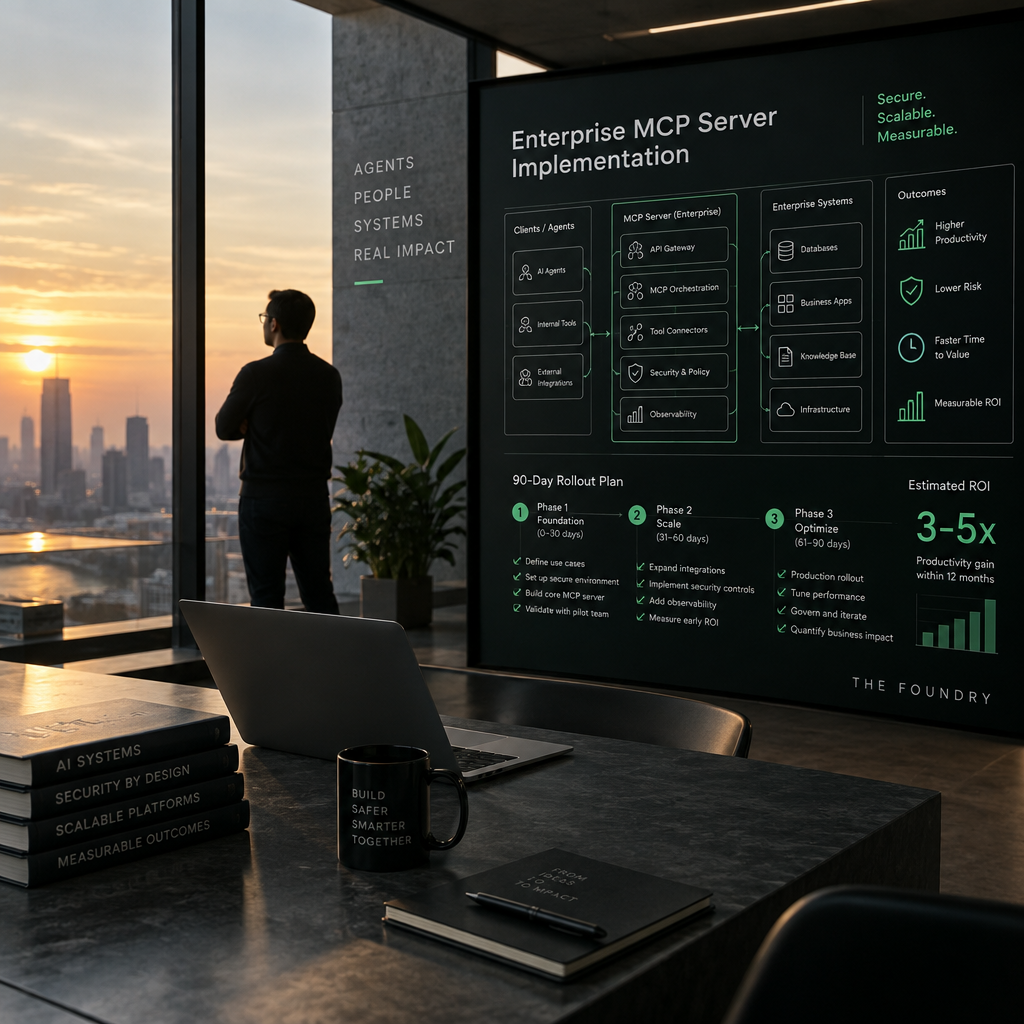
Enterprise mcp server implementation requires a structured approach to connecting AI models to enterprise tools. As agentic systems grow, security and governance become critical priorities. Palma.ai recently raised funding to address this need in the market. You must prioritize architecture and authentication from day one of your project.
The New Governance Landscape
Engineering teams now face board-level concerns about AI agent governance. On September 28, 2026, Palma.ai announced $1.8 million in pre-seed funding. This capital will support governance layers for MCP-connected AI agents. Investors include D11Z and executives from major tech firms. You should treat MCP governance as a key risk management task.
The Model Context Protocol specification now includes stateless core features. Version 2026-07-28 removes session handshakes. This change enables load balancer-based scaling without sticky sessions. Your architecture team must account for this shift in state management. It simplifies horizontal scaling but requires careful client design. Refer to the MCP specification for details.
Core Architecture Primitives
Enterprise MCP deployments rely on three core primitives. Resources are read-only data accessed by models. Tools represent executable actions that agents can invoke. Prompts serve as reusable templates for standardized interactions. All operate over JSON-RPC 2.0 as the transport layer.
You need to define these primitives clearly before development. Tools are exposed via the tools/list and tools/call methods. Schema validation is mandatory for all inputs to prevent errors. This ensures that downstream enterprise systems process data safely. Use the SDK decorators to register these resources efficiently.
Security and Authentication Controls
Security remains the primary concern for any enterprise mcp server implementation. You must implement OAuth 2.1 with PKCE for remote deployments. TLS 1.3 is recommended for all connections to ensure encryption. Static API keys are still used by over half of servers. The OWASP MCP Top 10 identifies credential management as a leading risk.
Avoid relying on static credentials for production workloads. Use enterprise identity providers like Okta or Azure AD for SSO. Integrate a secrets manager such as AWS Secrets Manager or HashiCorp Vault. Audit logging must have a minimum retention of 90 days. This supports SOC 2 Type II and HIPAA compliance requirements.
MCP Gateway Architecture Design
A reliable mcp gateway architecture requires three core components. The authentication layer validates OAuth 2.1 tokens using your IdP. The routing layer maps tool namespaces to specific backend servers. The observability layer handles structured logs and metrics. OpenTelemetry or SIEM tools work well for this purpose.
Token optimization is essential when connecting multiple servers. Bifrost Code Mode can reduce input token usage by up to 92.8%. This savings becomes significant when connecting 16 or more MCP servers. Plan your gateway to handle these optimizations automatically. Read more about The Foundary, Engineering Digital Foundations for broader context.
Step by Step Process
You should follow a phased rollout plan to ensure stability. Start with foundation setup before building the first server. Hardening occurs in the middle weeks before production deployment. This timeline helps manage technical debt and security risks effectively.
Weeks 1-2 focus on foundation tasks. Set up enterprise identity provider integration first. Configure secrets manager and deploy MCP gateway infrastructure. Establish network isolation and TLS 1.3 configuration during this time.
Weeks 3-4 involve building the first server. Use FastMCP for Python or typescript-sdk for TypeScript. Define tools, resources, and prompts using SDK decorators. Test locally using MCP Inspector to debug connection issues.
Weeks 5-6 prioritize gateway hardening. Configure rate limiting and DLP scanning on the gateway. Implement tool allow-listing and RBAC policies for access. Set up structured audit logging with at least 90 days of retention.
Weeks 7-12 cover the production rollout. Containerize MCP servers using Docker base images. Deploy to Kubernetes with Horizontal Pod Autoscaler. Enable CI/CD pipeline with security scanning steps.
Cost Analysis and ROI
Your budget should account for build versus buy decisions. Building custom servers costs $16,000 to $32,000 upfront. Maintenance adds another $6,000 to $13,000 yearly. Managed solutions often start at $29 to $499 monthly. Free tiers exist for open source options like TrueFoundry.
| Platform | Deployment | Auth | Catalog | Pricing | Best For |
|---|---|---|---|---|---|
| Bifrost | Self-hosted | OAuth 2.0 | Virtual MCPs | Open source | Enterprise governance |
| Composio | Managed cloud | End-user OAuth | 1,000+ toolkits | Free tier | Developer-first integration |
| Microsoft MCP Gateway | Kubernetes | Bearer token | Bring your own | Free | Azure teams |
| Docker MCP Gateway | Containers | Credential injection | Docker Catalog | Free | Local environments |
TrueFoundry Pro Plus includes SSO and compliance features. It costs $499 monthly for professional tiers. Infrastructure costs vary based on your cloud provider. Cloudflare Workers offer a free tier covering 100,000 requests daily. Evaluate your expected query volume before selecting a host.
Scaling and Observability
Scaling horizontally without sticky sessions is now easier. The stateless protocol core enables standard load balancing. You can use Kubernetes Horizontal Pod Autoscaler for dynamic scaling. This adjusts capacity based on real-time request metrics. Ensure your gateway handles load distribution correctly.
Observability is critical for identifying bottlenecks early. Use structured logs to track tool invocations and latency. Monitor token usage to manage operational costs effectively. Alert your team on authentication failures or schema errors. These metrics support your reliability goals.
Supply Chain Security Requirements
Supply chain security prevents compromised servers from entering your network. Static application security testing should run on all code. Vulnerability scanning checks dependencies for known flaws. Cryptographic verification ensures server integrity before deployment. These steps protect your agentic AI systems from external threats.
Docker provides container-based isolation for local deployments. Kubernetes adds another layer of runtime protection in production. Keep base images updated to avoid security issues. This maintains your trust boundaries between internal and external systems. Review the Privacy Policy for data handling details.
Talk to a counsellor
Start a conversation with The Foundary about your platform or AI project. Our team can help you design and deploy secure MCP gateways for your needs. Reach out today to discuss your architecture requirements.
Conclusion
Building a secure MCP server requires careful planning and strict adherence to standards. You must implement OAuth 2.1, TLS 1.3, and proper audit logging from the start. Follow a phased rollout to manage risks and ensure compliance. This disciplined approach protects your enterprise data while enabling agentic AI growth.
Frequently Asked Questions!
1. How do I migrate from stdio transport to Streamable HTTP?
You must update client libraries to support HTTP transport. Ensure your gateway handles session state correctly during the switch. Test connectivity thoroughly before decommissioning local streams.
2. What is the recommended approach for long-running tool calls?
Use streaming responses or background job patterns. You should implement webhooks to notify clients upon completion. This avoids timeout errors during execution.
3. How do I implement per-user OAuth 2.1 flows?
Configure the IdP to issue tokens tied to user identity. Validate the user scope in your gateway policies. This ensures agents act only within approved boundaries.
4. What controls prevent confused-deputy attacks?
Enforce strict RBAC and tool allow-listing on the gateway. Verify caller identity at every request layer. This limits what any single component can access.
5. How do I scale MCP servers without sticky sessions?
Use a stateless protocol core and standard load balancers. Avoid storing session data on server instances. This allows any node to handle any request.
6. How do I implement human-in-the-loop approval gates?
Integrate a workflow system for destructive operations. Require explicit token approval before executing actions. This adds a critical safety check for sensitive tasks.