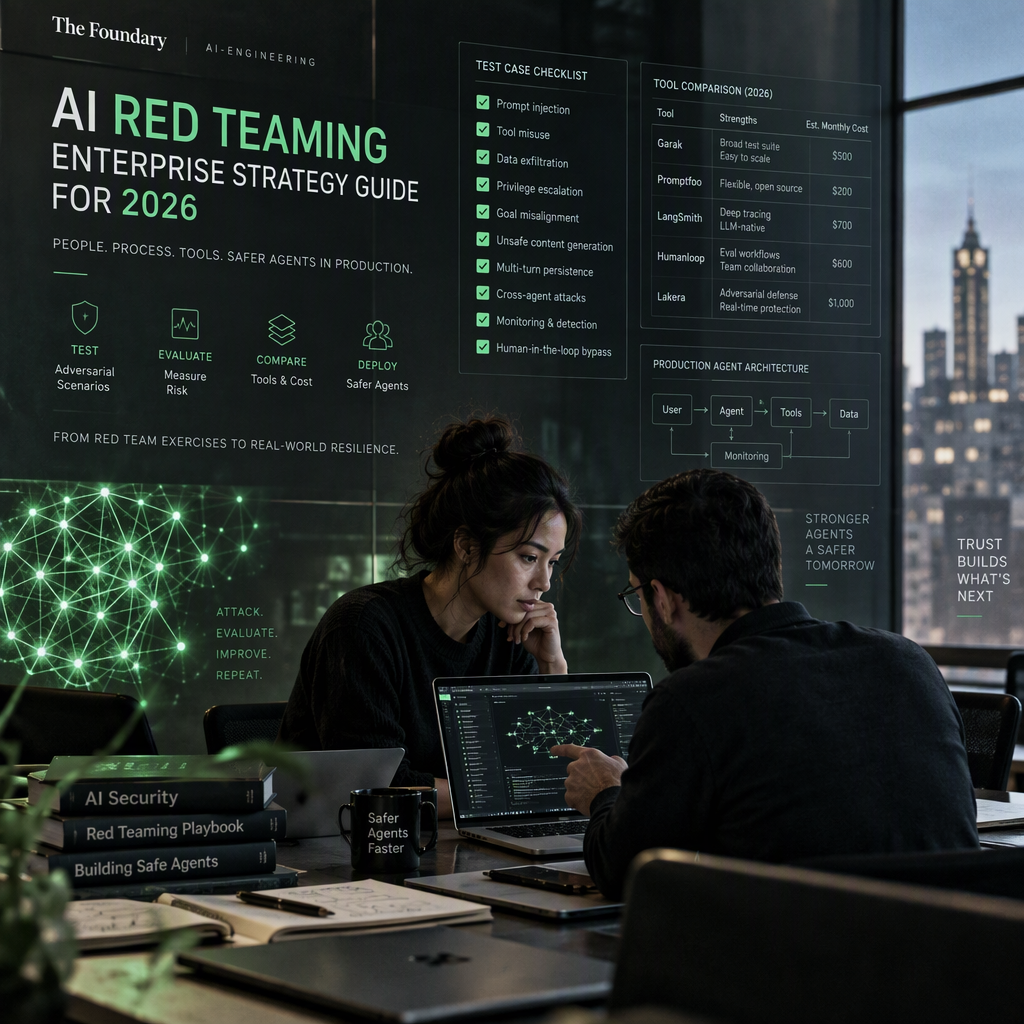
You need ai red teaming enterprise strategies now. The regulatory landscape changed when the EU AI Act enforcement deadline arrived on August 2, 2026. Organizations deploying high-risk systems must implement documented risk management or face fines up to €15 million. IBM reports AI-enabled breaches cost an average of $6 million in 2026. This financial risk makes adversarial testing mandatory rather than optional for your team.",
Why Compliance Drives AI Red Teaming Enterprise Demand
The EU AI Act now requires providers to implement automatic logging and technical documentation. Articles 11 and 12 mandate record-keeping for high-risk system operations as of August 2, 2026. Non-compliance risks fines of up to €15 million or 3% of global annual turnover. This enforcement shifts adversarial testing from a best practice to a budget line item. You cannot launch high-risk agents without a valid testing regimen.",
ai red teaming enterprise Standards
Industry standards define what a reliable testing program looks like. Teams map findings to the OWASP Top 10 for LLM Applications and MITRE ATLAS. These frameworks help you identify common vulnerabilities like prompt injection and indirect prompt injection. Open-source tools often include built-in mappings to these standards out of the box. You can use these mappings to ensure comprehensive coverage across your agent interfaces. Mindgard Blog explains how offensive security platforms automate this mapping.",
Tool Selection for Production Agents
Choosing the right tools depends on your integration needs. You should prioritize solutions that fit into your CI/CD pipelines to catch issues early. Check out HKLAW Insights for detailed compliance timelines before you begin. The following platforms offer distinct capabilities for different testing phases.
| Platform | Type | Best For | Pricing Model |
|---|---|---|---|
| Mindgard | Commercial SaaS | Pre-launch and continuous red teaming | Enterprise Quote |
| Lakera / Check Point | Commercial API | Runtime guardrails and injection detection | Free Tier + Quote |
| Garak | Open Source | LLM vulnerability scanning | Free |
| Promptfoo | Open Source | CI/CD integration and regression testing | Free + Enterprise |
Garak and Promptfoo are free options that support open-source workflows. Mindgard and Lakera provide enterprise support and deeper integration features. Your engineering team might prefer open-source tools if they have Python expertise. Commercial platforms often reduce maintenance overhead through managed services.",
Enterprise AI Security Testing Costs
Costs vary significantly based on whether you build or buy solutions. Manual red team assessments by US professionals cost $59 to $84 per hour. A typical two to six week engagement ranges from the low five figures to the low six figures. Contractors average around $67.60 per hour for these specialized tasks. You must also account for the total compensation of full-time red teamers. According to ZipRecruiter data, US red teamers earn between $80,000 and $220,000 annually.
| Approach | Estimated Cost | Effort Required |
|---|---|---|
| Build (Open Source) | Salary $80k-$220k | High maintenance and expertise |
| Buy (Commercial) | Manual testing starts at $5k-$15k per engagement | Automation compresses costs |
Automating security operations can cut breach costs by an average of $2 million. Investing in automated tools allows your team to test more frequently. Manual testing remains necessary for complex human oversight scenarios. You should mix both approaches to balance cost and depth.",
Implementation Steps and Timeline
You can follow a structured process to deploy a red team program effectively. Start by cataloging your systems and classifying them against EU AI Act categories. Then select a primary tool based on your budget and internal skills. This timeline helps you meet compliance deadlines efficiently.
- Inventory & Classification: Week 1 to 2
- Tool Selection: Week 3
- Baseline Scanning: Week 4
- Integration: Week 5 to 6
- Documentation: Week 7
- Human Oversight Design: Week 8
- Ongoing Monitoring: Quarterly
Each step requires specific outputs like technical documentation or logging configurations. Article 26 of the AI Act requires deployers to retain logs for at least six months. Ensure your tool selection supports long-term data retention requirements.",
Handling Skills and Talent Gaps
Your team needs specific skills to operate modern security tools effectively. Proficiency in Python or TypeScript is required for using open-source tools like Garak. You also need familiarity with LLM architecture and RAG security. Mappings to compliance frameworks like NIST AI RMF are essential for audits. If you lack internal staff, you may rely on external contractors. External resources can fill gaps during peak compliance periods.",
Business Case and ROI
Demonstrating value to the CFO requires clear financial metrics. The average cost of an AI-enabled breach is $6 million as of 2026. A controlled testing expense of $5,000 to $100,000 provides a significant return on investment. Organizations using AI in security operations cut breach costs by an average of $2 million. You should highlight these savings in your budget requests. Protecting your reputation is also a critical intangible benefit.",
Pitfalls to Avoid
Several common mistakes can undermine your testing program. Relying only on static analysis fails to catch runtime vulnerabilities. Ignoring human oversight requirements exposes you to non-compliance risks. Using outdated benchmarks like those before 2025 leads to false security. Ensure your testing covers the latest attack vectors found in MITRE ATLAS. Regular updates to your threat model keep your defense relevant over time.",
Future Outlook for Adversarial Testing
The tools in this space will continue to evolve rapidly. Promptfoo gained significant attention after its acquisition by OpenAI in March 2026. Microsoft’s PyRIT framework was archived in March 2026, shifting focus to active projects. You must monitor these changes to maintain a modern security posture. Staying current with new vendors ensures you use the best available technology.
Talk to a Foundry engineer
Tell us about your AI platform or security project. Talk to The Foundary about AI
Conclusion
The path forward requires treating AI red teaming as a core operational function rather than an add-on. By aligning with established frameworks like OWASP and MITRE you ensure your defenses are comprehensive. Your team should prioritize tools that automate routine checks while preserving human oversight for complex cases. These steps will help you mitigate financial risks and meet strict regulatory requirements.
Frequently Asked Questions!
1. How do I handle EU AI Act compliance for AI agents deployed outside the EU but serving EU users?
The EU AI Act applies if your high-risk systems are used by entities in the EU. You must implement the required risk management and logging controls regardless of physical server location.
2. What is the difference between a red team and runtime guardrails?
Red teaming involves proactive adversarial testing to find vulnerabilities before deployment. Runtime guardrails monitor live traffic to block attacks as they happen. Both are recommended for complete protection.
3. How do I validate that my red teaming tool covers OWASP Top 10 2025 risks adequately?
Check if your tool maps findings to OWASP Top 10 for LLM Applications. Vendors often publish reports showing this alignment.
4. What is the cost impact of open-source tools like PyRIT after its archiving in March 2026?
Archived tools like PyRIT may lack updates. You should migrate to active open-source alternatives like Garak or Promptfoo to ensure support.
5. How do I calculate the ROI of AI red teaming to justify budget to the CFO?
Compare the cost of testing against the average AI breach cost of $6 million. Highlight potential savings from automated security operations.
6. Which AI red teaming tools are approved for self-hosted or air-gapped environments?
Open-source tools like Garak and Promptfoo are best for self-hosted environments. Commercial solutions may offer on-prem options upon enterprise request.
By the Foundry Engineering Team · Updated 2026-09-30