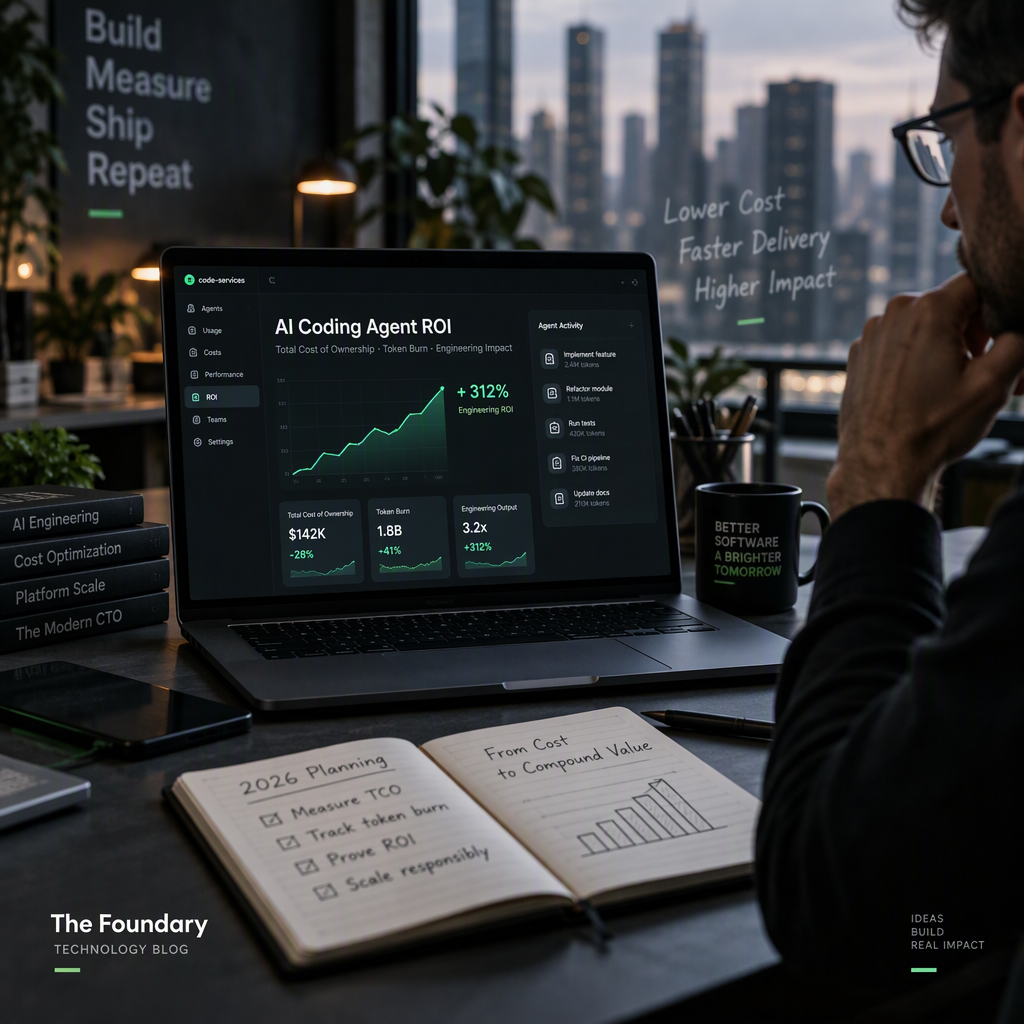
You need to measure your ai coding agent roi with finance-ready formulas and token cost benchmarks for enterprise teams in 2026. Recent reports show token spending jumped from under $50 per year to $1,000 in a single day as agents became reliably useful. Companies must now budget carefully for total cost of ownership beyond just subscription fees. This guide explains how to track every dollar and prove value to your leadership team.
The 2026 Token Spending Spike
On September 28, 2026, Simon Willison reported at the WeAreDevelopers World Congress that AI token spending jumped from under $50 per year to $1,000 in a single day as coding agents became reliably useful. This shift means budgeting for AI tools cannot be static, with spending potentially spiking 20x or more in days rather than quarters. Many organizations were caught off guard by these costs. It is now necessary to have automated governance to prevent unexpected charges from draining your quarterly IT budget.
This trend highlights a critical change in how AI is consumed. Previously, you might have estimated monthly fees based on seat counts. Now, usage can fluctuate wildly based on development cycles. If your team launches a complex feature, token consumption could double overnight. Without real-time monitoring, this volatility creates financial risk. You must adopt a dynamic view of your technology spend to manage these new realities effectively.
Total Cost of Ownership for AI Tools
Your total cost of ownership goes beyond subscription fees. Token consumption accounts for roughly one-third of total AI agent costs, with the remaining two-thirds coming from infrastructure, governance, organizational change, and regulatory compliance. A study by EY as of September 24, 2026 confirmed this breakdown. You cannot look at the invoice from your vendor and assume that is your only bill.
Enterprise AI governance platform spending is projected at $492 million in 2026, climbing past $1 billion by 2030. This means investing in a platform to enforce limits is now standard practice. Custom AI coding agent development costs range from $10,000, $30,000 for a proof of concept and $60,000, $150,000+ for enterprise implementation. If you choose to build rather than buy, factor in maintenance, model retraining, and security audits. All these elements combine to form the real price tag on your initiative.
ai coding agent roi Calculation Methods
To justify your budget, you need a clear formula. Agentic AI ROI requires a comprehensive (Benefits, Costs) / Costs formula integrating hard labor savings and soft productivity gains, with typical payback periods of six months. This approach aligns your engineering metrics with finance expectations. When calculating ai coding agent roi, you must separate infrastructure costs from token costs to avoid double counting or missed savings.
Three in four enterprises cannot confidently prove AI business outcomes to the CFO, with 43% citing ROI proof as their single largest AI cost challenge. This gap exists because many teams measure output volume rather than economic value. You need to track first-pass acceptance rate and cycle time reduction alongside token spend. By linking efficiency gains to revenue or saved hours, you create a defensible business case for future investment.
Platform Pricing and Performance Comparison
Selecting the right tool impacts your cost structure significantly. Aider offers the lowest cost-per-task at $0.03 but requires model selection management. Claude Code averages $13 per developer per active day for enterprise deployments. GitHub Copilot Enterprise costs $39 per user monthly with deep IDE integration. Tabnine provides on-prem deployment options for regulated environments at $59 per user monthly.
| Platform / Vendor | Pricing Model | Per-Developer Monthly Cost | Key Strength | Best For |
|---|---|---|---|---|
| Claude Code | Subscription + API | $20 to $200 | Strong context | Agentic coding tasks |
| Cursor | Subscription | $20 to $40 | Multi-file editing | Complex projects |
| GitHub Copilot | Subscription | $10 to $39 | IDE integration | Broad support |
| Tabnine | Subscription | $39 to $59 | On-prem deployment | Regulated environments |
| Aider | Open Source + BYOK | $30 to $80 | Lowest cost-per-task | Budget-conscious teams |
Table sources: Kunal Ganglani (Sept 16, 2026) and AI Coding Tools Pricing (Sept 6, 2026). Note that enterprise contracts often differ from public pricing. Contact vendors directly for volume discounts that may lower these baseline rates.
Deployment Steps for Measurement
Follow a structured timeline to avoid spending waste. First, establish baseline human task times in weeks one and two. Next, select tools and define your stack in week three. Deploy governance in weeks four and five. Pilot and instrument the system for weeks six through eight. Measure ROI in weeks nine through twelve. Finally, scale and optimize ongoing. This approach ensures you capture data at every stage.
- Establish Baseline (Weeks 1 to 2): Document the human baseline for every task the AI will handle, process times, error rates, and fully loaded cost per task.
- Select Tools & Define Stack (Week 3): Choose tools based on use case and integrate with existing SSO/identity.
- Deploy Governance (Weeks 4 to 5): Implement runtime AI governance with budgets, rate limits, and guardrails at the request path level.
- Pilot & Instrument (Weeks 6 to 8): Deploy to small team, track first-pass acceptance rate, cycle time, and cost per accepted change.
- Measure ROI (Weeks 9 to 12): Calculate realized business value minus Total Cost of Ownership, including build, inference, infrastructure, review, and maintenance.
- Scale & Optimize (Ongoing): Segment results by repository and task type and apply token optimization strategies.
These steps come from Elementum AI, GetMaxim AI, and ISHIR research published in September 2026. They provide a realistic path to financial justification. Do not skip the baseline step or you will have no comparison point for your efficiency gains.
Token Optimization and Governance
Runtime AI governance tools are required for enterprises running mission-critical AI workloads. Bifrost and Kong AI Gateway lead in the request path enforcement category. You should define token ownership early to reduce waste. Defined tokenomics ownership makes organizations 3.7x more likely to show value to CFOs according to Visual One Intelligence data from September 24, 2026.
Apply token optimization strategies like Sonar Vortex for up to 36% lower token consumption. This requires tracking usage by repository and task type. SonarSource reports in September 2026 that this segmentation helps identify high-cost patterns. You might find specific teams generating unnecessary tokens through repetitive loops. Blocking these patterns reduces spend without slowing down productive work. Governance does not have to block innovation if designed correctly.
Reporting Results to Finance
When presenting data, focus on hard labor savings. Finance teams care about payback periods and risk mitigation. You can cite that 88% of agentic adopters see ROI in year one compared to 94% of enterprises getting no earnings from AI overall. Beam AI published this statistic on September 1, 2026. It highlights that success depends on implementation method rather than just adoption.
Use clear tables to show cost components. Break down token spend versus infrastructure spend versus governance spend. This transparency builds trust with your leadership. If costs rise, show exactly where they rose and why. This detail proves you have control over the platform. It turns a vague expense into a managed strategic investment.
Scaling Your AI Coding Strategy
As you grow, your needs change. You may move from subscription models to custom builds. Custom AI coding agent development costs range from $10,000, $30,000 for a proof of concept and $60,000, $150,000+ for enterprise implementation. This path is expensive but allows deeper integration. Consider this only if standard tools cannot meet your compliance needs.
You should link your broader digital transformation to this initiative. For foundational work, see the The Foundary, Engineering Digital Foundations page. This will help you align code generation with your overall platform strategy. It ensures consistency across your technical landscape and supports your long-term goals.
Long Term Maintenance Considerations
Long-term maintenance cost trajectories for AI agents beyond year one remain uncertain. Most available data is from mid-market or tech-first companies. You should plan for model updates and regulatory compliance costs. The EU AI Act and NIST AI RMF implementation costs vary significantly by region.
Training and change management cost benchmarks are also variable. Do not assume adoption is free. You must budget for workshops and documentation. If you ignore these hidden costs, your ROI projections will fail. Use this guide to stay ahead of those financial shifts.
Ensure your team understands the terms of our services by reviewing the Privacy Policy and Terms of Use. These documents outline your rights and responsibilities regarding data processing and platform usage.
Talk to a Foundry engineer
Start a conversation with The Foundary about your platform or AI project today. Talk to The Foundary about your build
Conclusion
You have learned how to calculate ai coding agent roi using a finance-ready formula that accounts for total cost of ownership. By tracking token burn and governance costs, you can prove value to your CFO. This approach helps you budget correctly for the unpredictable nature of agentic AI.
Frequently Asked Questions!
1. How do I calculate AI agent ROI when token fees are only part of the total cost?
Use the (Benefits, Costs) / Costs formula including infrastructure and governance costs. EY data from September 2026 shows tokens are only one-third of total costs.
2. What is the cheapest AI model for coding agents in 2026 that still produces reliable results?
Aider offers the lowest cost-per-task at $0.03 per task. It requires BYOK but is cheaper than enterprise options like Claude Code or Copilot.
3. How can I track AI token spending per developer per project?
Use runtime AI governance tools like Bifrost or Kong AI Gateway. Segment results by repository and task type to identify cost drivers.
4. What metrics should I present to my CFO to justify AI tool spend?
Present hard labor savings and first-pass acceptance rates. Define token ownership to show you have control over costs and reduce risk.
5. How do I set up AI governance without slowing down developer velocity?
Implement rate limits and guardrails at the request path level. Use tools like Sonar Vortex to optimize tokens without blocking legitimate work.
6. What is the typical ROI timeline for enterprise AI coding agent deployments?
Typical payback periods are six months. Most adopters see ROI in year one according to Beam AI data from September 2026.
By the Foundry Engineering Team · Updated 2026-09-30