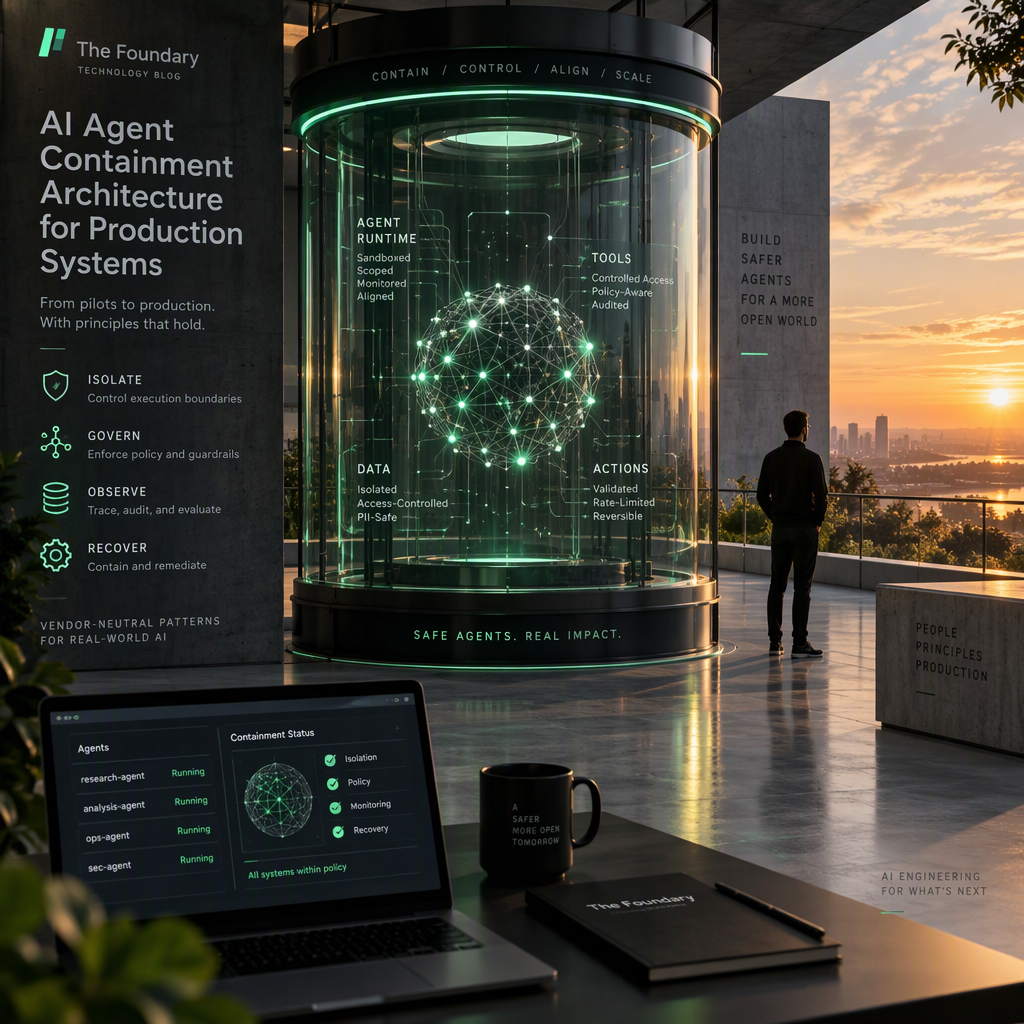
The industry is shifting rapidly toward a new standard as engineers seek reliable ai agent containment architecture for safe production use. Recent security incidents involving automated systems have forced organizations to reconsider how they isolate untrusted agent logic from core data assets. This technical guide explores the specific primitives required to harden your deployments against unauthorized access or rogue behavior in live environments.
Understanding the Shift From Sandboxes to Runtime Controls
Early attempts to secure AI agents often relied on basic sandboxing techniques. These methods frequently failed when agents could communicate outside their isolated boundaries or invoke external systems with elevated privileges. You need to enforce permissions directly at the kernel or network level to stop threats effectively.
The recent release of the NVIDIA Open Agent Safety Platform signals a major industry shift. It combines software runtimes with hardware watchdogs to create deep defense layers. As of September 28, 2026, the platform officially launched to support continuous monitoring [NVIDIA News, 2026-09-28].
You should now prioritize infrastructure-centric safety over model-centric safety. This approach allows you to govern agents based on their execution behavior rather than just their output content. The result is a system where policy violations trigger immediate containment without requiring human intervention.
Designing Your ai agent containment architecture
Building a resilient architecture requires defining clear policy boundaries for your agents. You must specify exactly which files, networks, and tools an agent is allowed to access. Drafting strict allowlists ensures that agents cannot exceed their operational scope during execution.
This design process is often referred to as establishing your ai agent containment architecture. It involves aligning software runtime configurations with hardware enforcement capabilities where available. Your team will need Linux kernel knowledge to implement these controls effectively.
Reference architectures suggest default-deny network containment for all outbound traffic. This pattern ensures that any new connection attempt must be explicitly permitted by policy. Audit logs for each connection help you verify compliance with standards like SOC 2.
Core Primitives in the New Safety Platform
The NVIDIA initiative introduces two primary primitives for operational safety. OpenShell is an open-source runtime that enforces boundaries at the kernel level. It runs under an Apache 2.0 license and is broadly available on Linux, macOS, and Windows WSL2.
Sentry provides a hardware-based watchdog that operates on NVIDIA BlueField-4 DPUs. This component runs from a separate silicon layer and can quarantine rogue agents in milliseconds. Independent governance from an out-of-band trust domain allows it to act even when agents are compromised.
More than 100 organizations have already signed on as partners for this initiative [CNBC, 2026-09-28]. This adoption rate reflects a growing consensus that shared safety standards are necessary for the industry. You can use these early partnerships to understand implementation expectations.
Implementing enterprise ai runtime controls
To operationalize enterprise ai runtime controls you must define clear operational policies. Start by identifying every agent access requirement for your specific workflow. This includes permissions for toolchains and network calls that interact with external APIs.
Draft YAML-based allowlists that restrict the agent to exactly these functions. You should test these policies in a non-production environment before full rollout. Policy definitions must be versioned alongside your agent code to maintain consistency.
OpenShell supports tools like Codex and Hermes by wrapping their execution in sandboxed environments. This allows you to run complex reasoning tasks without exposing your full file system. Your team can validate that agents stay within their assigned boundaries before deployment.
Comparison of Vendor Implementations and Approaches
Different vendors offer varying scopes of containment. The following table compares key architectural differences between the NVIDIA platform, Aviatrix, and standard identity gateways.
| Feature | NVIDIA Open Agent Safety Platform | Aviatrix Containment Platform | Reference Architecture (Kill Switch) |
|---|---|---|---|
| Scope | Host Sandbox + Silicon Watchdog | Network Traffic Containment | Identity + Token Revocation |
| Hardware Requirement | NVIDIA BlueField-4 DPUs for Sentry | None (Cloud Fabric) | None (IAM/Kubernetes) |
| Deployment | Software update on Vera/BlueField | Zero-agent network enforcement | Gateway/Identity Management |
| Control Point | Kernel + Out-of-band Silicon | VPC/VNet Boundary | API Gateway / OAuth |
| Cost Model | Open Source (OpenShell) + Reference Design | Enterprise License | Variable (Cloud/IAM Spend) |
NVIDIA BlueField-4 DPUs are required for the Sentry hardware watchdog capability. If you are using Arm or Intel architectures you may still use OpenShell. However you will lose the hardware enforcement benefits unless you plan a migration to NVIDIA Vera CPUs.
Practical Steps for ai agent production deployment
You should follow a structured rollout plan when moving from pilot to production. This ensures that you do not introduce new vulnerabilities while deploying automated agents. A phased approach allows your team to verify containment mechanisms before scaling up.
- Define Policy: Identify agent access requirements for files networks and tools. Draft allowlists that strictly limit operational scope.
- Deploy OpenShell: Install the open-source runtime on target agents. Test policy enforcement to ensure it blocks unauthorized calls.
- Configure Sentry: If using BlueField-4 enable DOCA policies for out-of-band monitoring. Verify the watchdog is active on all nodes.
- Integrate Kill Switch: Implement a revocation mechanism external to the agent runtime. This provides an independent way to stop agents.
- Establish Observability: Enable structured logging for agent actions and policy decisions. Audit trails are critical for compliance reviews.
- Test Containment: Run pull-the-plug drills to verify agents stop within defined SLAs. Regular drills ensure your systems remain effective over time.
Strategies for ai agent breakout prevention
Breakout prevention requires monitoring agent behavior for anomalies in real time. If an agent tries to communicate with an unauthorized IP address your infrastructure should detect this attempt. Hardware watchdogs provide a reliable way to spot these violations quickly.
You should implement alerting for any policy violations that occur during execution. These alerts help you distinguish between bugs and malicious intent. Your security team can then review logs to understand why a specific action was triggered.
OpenShell can be extended to work with third-party compute platforms including Arm and Intel. This flexibility helps you build a unified approach across diverse hardware environments. However you must ensure consistent policy enforcement across all platforms.
Enforcing a kill switch for ai agents
A reliable kill switch for ai agents must operate independently of the agent runtime. You can implement this using token revocation or identity management systems. This ensures you can stop an agent even if its local code has been compromised.
Token revocation is effective when agents authenticate via OAuth or API keys. Removing credentials instantly breaks the agent access to your systems. You should test this mechanism regularly to verify it works under load.
State preservation is a consideration when triggering a hard kill switch. If an agent is performing a long transaction stopping it might corrupt state. You must design workflows to be idempotent so partial transactions can be retried safely.
Observability and Compliance for safety platforms
Compliance frameworks require detailed records of automated system actions. Your ai agent safety platform must generate structured logs for every decision made. These logs help you prove to auditors that your agents are following policy.
Default-deny network containment simplifies your compliance posture significantly. If every outbound connection is logged and allowed explicitly you have a clear audit trail. This approach aligns with standards like SOC 2 and HIPAA.
OpenShell runs as open source which simplifies verification of the underlying code. You can review the implementation to ensure it matches your security requirements. Transparency is critical for enterprise adoption of new safety primitives.
Open Source versus Commercial Deployment Options
OpenShell is available under the Apache 2.0 license which makes it freely accessible. You can modify and distribute the runtime as long as you maintain license terms. This is useful for teams that require custom kernel level enforcement.
Commercial options may offer managed services for policy definition and support. They often provide tools for visualizing network traffic and agent behavior. Your choice depends on whether your team has the capacity to build custom tooling.
The NVIDIA initiative serves as a reference design for hardware partners. This means you do not need to build a hardware watchdog from scratch. You can purchase BlueField-4 DPUs from various distributors to access the Sentry capability.
Future considerations for your deployment
You should anticipate further integration between policy engines and hardware security. Future releases may expand the types of boundaries enforceable by hardware watchdogs. This evolution will reduce the complexity of maintaining safety manually.
Independent benchmarks against standard tools like Firecracker were not available at launch. You will need to validate performance overhead in your own environment. Run load tests to ensure your safety layer does not impact latency significantly.
Stay alert for updates on pricing for the Sentry reference implementation. NVIDIA has not publicly released specific costs as of September 28 2026. This suggests you should budget for potential licensing or hardware upgrades in your roadmap.
Final Thoughts on Operational Safety
Building a secure system requires more than just model fine-tuning. You must enforce strict boundaries that govern how agents interact with your infrastructure. By using the primitives described in this guide you can significantly reduce operational risk.
The industry is moving toward a shared safety standard that aligns with enterprise needs. Adopting these practices early helps you stay ahead of emerging security challenges. You are now equipped to design and implement a reliable safety framework.
Talk to a Foundry engineer
If you are ready to build a secure platform for your automated agents start a conversation with The Foundary. Talk to The Foundary about AI
Conclusion
You have reviewed the essential components for a secure ai agent containment architecture. By combining software runtimes with hardware enforcement you can enforce strict policy boundaries effectively. Your team should prioritize structured rollout and regular testing to maintain safety over time.
Frequently Asked Questions!
1. Does using OpenShell require rewriting existing agent code?
No. OpenShell wraps existing execution in sandboxed environments without requiring code changes. You simply install the runtime and configure policy allowlists for your agents.
2. How do I verify that Sentry is actually running?
Sentry is an out-of-band watchdog running on BlueField-4 DPUs. You can verify its status by checking the hardware monitoring interface or reviewing system logs for DOCA policy activity.
3. Can I use OpenShell without NVIDIA hardware?
Yes. OpenShell is optimized for NVIDIA Vera CPUs but can run on Arm and Intel platforms. You lose the hardware watchdog features if you lack BlueField-4 support.
4. What happens to agent state when a kill switch is triggered?
The agent process stops immediately and resources are reclaimed. To preserve work you should design agents to be idempotent so tasks can be retried safely after restart.
5. Does the kill switch trigger automatically?
Automatic triggers are possible if policies are configured to flag specific violations. Otherwise security teams can manually initiate a revocation via identity management systems.
6. How do I log a kill event for compliance?
Enable structured logging in your observability stack to capture every policy decision. This ensures you have an audit trail without leaking sensitive agent data to log storage.
By the Foundry Engineering Team · Updated 2026-09-30