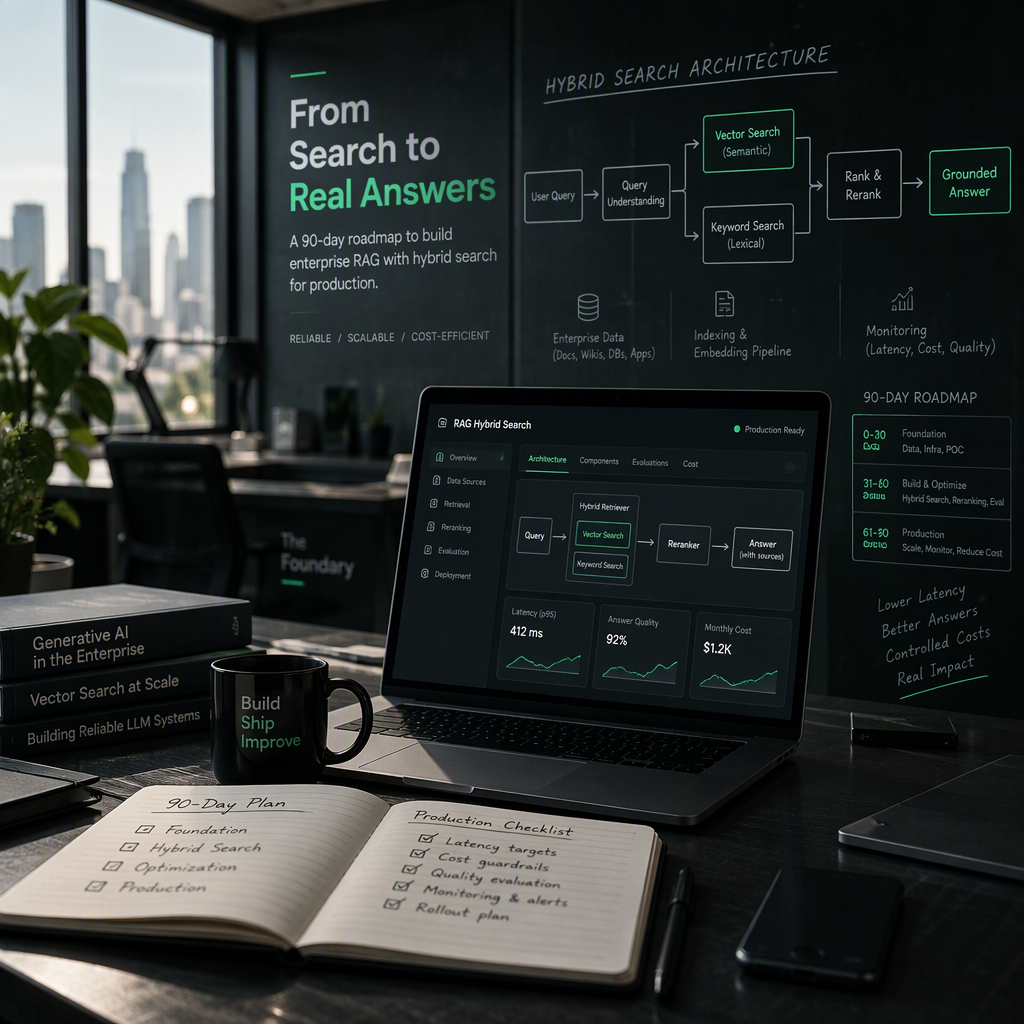
When building an enterprise rag hybrid search system, accuracy and latency define success. Recent September 2026 benchmarks show that combining hybrid search with sentence window chunking delivers the highest accuracy gains at the lowest complexity. You need a proven architecture to handle mixed document corpora without excessive engineering overhead. This guide outlines a 90-day roadmap for production-grade deployment. We will examine cost metrics, platform choices, and compliance requirements needed for scale.
The Business Case for Hybrid Search
Enterprises are increasingly moving beyond dense-only retrieval models. VentureBeat reports that enterprise intent to adopt hybrid retrieval tripled from 10.3% to 33.3% in Q1 2026 as RAG programs hit the scale wall. Hybrid systems solve a dual problem by capturing both exact-term matches and semantic similarities. This reduces the chance of missing critical identifiers or product codes in your data. The WANDS e-commerce benchmark demonstrated a 7.4% NDCG lift over BM25 alone for Digital Applied in October 2026. These improvements translate directly to better user outcomes and fewer support tickets.
Sphere confirmed in September 2026 that a hybrid pipeline with reranking achieved 91% answer relevance versus 71% for vector-only retrieval on mixed enterprise corpora. Such gains are essential for customer-facing search where accuracy impacts revenue. Without hybrid mechanisms, you risk relying solely on embeddings which can miss keywords. Your users expect immediate answers that align with their specific vocabulary. Investing in hybrid search early prevents costly rewrites later in your product lifecycle.
Design Your enterprise rag hybrid search Architecture
A reliable stack requires specific tools for each stage of the pipeline. DataStorage recommends Python with LangChain or LlamaIndex for orchestration. For vector storage, choose Qdrant or Pinecone to support your scaling needs. Cohere Rerank v3 helps you apply cross-encoder reranking to boost precision. RAGAS serves as your evaluation framework to track metrics continuously. You must define these components before writing code to avoid integration bottlenecks. Clear architecture ensures your team can onboard quickly and stay aligned on standards.
Compliance prerequisites include RBAC or ABAC at the document level. Encryption standards require AES-256 at rest and TLS in transit. You also need PII redaction and audit logging across the pipeline according to Synvestable. These requirements protect user data and maintain trust in your system. Skipping security design during prototyping often leads to delays during production rollout. Treat security as a core feature rather than an afterthought for your platform.
The 90-Day Implementation Roadmap
Follow a structured timeline to ensure steady progress and measurable results. Weeks 1 to 2 involve building a minimal RAG pipeline on a small corpus. Ship this to a small internal user cohort to capture all queries and responses. This initial feedback loop helps you understand real user needs before overengineering. You can then refine your data ingestion process based on actual usage patterns. Early shipping prevents building features nobody actually wants to use daily.
Weeks 3 to 4 require you to hand-curate 50 to 100 (query, ideal-answer) pairs. Stand up the evaluation harness and establish baseline recall@5 and faithfulness scores. These metrics form the foundation of your success definition and future improvements. Without a baseline, you cannot prove that your optimizations are working effectively. Your team needs these numbers to prioritize technical debt versus new features properly. Document your findings to help stakeholders understand the current state clearly.
Weeks 5 to 6 focus on adding hybrid retrieval combining BM25, dense, and RRF. Integrate a cross-encoder reranker and tune chunking based on observed failures. Adjusting chunk sizes early often yields significant gains in retrieval quality. Weeks 7 to 8 require you to instrument every stage with per-request traces. Set up latency and error-rate alerting to monitor system health closely. Build a trace viewer dashboard so your team can diagnose issues quickly. Visibility into the pipeline reduces mean time to resolution for production incidents.
Weeks 9 to 10 involve profiling per-stage cost to find inefficiencies. Add a query router to send easy queries to cheaper models efficiently. Implement semantic query caching to reduce redundant processing and save resources. Weeks 11 to 12 cover implementing index versioning and atomic cutover. Validate backup and restore procedures to ensure business continuity. Apply chunk-level access control and test PII redaction rigorously. This final phase ensures your system is safe and ready for external users. A completed roadmap provides a clear path to production without unnecessary delays.
Platform Comparison and Selection
Choosing the right vector database impacts both cost and performance. Weaviate achieved sub-100ms query performance at millions-of-vectors scale with native hybrid search and built-in RBAC. Qdrant delivers ~6ms P50 retrieval latency on its hybrid search implementation. Both options support self-hosting to reduce operational expenses over time. Managed solutions like Pinecone offer faster deployment but higher ongoing fees. You should weigh engineering effort against infrastructure costs when making this decision.
| Platform | Type | Open Source | Deployment | Best For | Pricing Tier |
|---|---|---|---|---|---|
| LangChain | Framework | MIT | Self-host/Cloud | Agentic workflows | Free + LangSmith $39/seat/mo |
| LlamaIndex | Framework | MIT | Self-host/Cloud | Complex document estates | Free + LlamaCloud credits |
| Pinecone | Vector DB | No | Cloud | Fastest path to managed production | ~$50/mo Standard; ~$500/mo Enterprise |
| Weaviate | Vector DB | BSD-3-Clause (core) | Self-host/Cloud | Hybrid search; regulated industries | ~$25/mo cloud; self-host free |
| Qdrant | Vector DB | Apache 2.0 | Self-host/Cloud | Hybrid search; server-side RRF | ~$0.10/GB/mo Cloud; self-host free |
| AWS Bedrock | Managed RAG | No | AWS | AWS-first enterprises | Per-token + storage |
This comparison highlights that open-source options provide flexibility for custom constraints. Self-hosting Weaviate or Qdrant can be cost-effective for high-volume queries. However, you must factor in maintenance time and security updates. Managed services simplify operations but lock you into specific pricing models. Review the pricing tiers carefully to forecast annual expenses accurately. Ensure your choice supports future growth without requiring a platform migration.
Latency and Performance Tuning
End-to-end RAG latency averaged ~865ms in production with LLM generation consuming 75% of the time. AI Log reported these figures in May 2026 indicating the generation step is the primary bottleneck. Optimizing retrieval alone yields minimal gains if the LLM response remains slow. You should focus on model selection and prompt efficiency to reduce generation time. Cross-encoder reranking adds 80 to 200ms but delivers 18 to 40% accuracy improvements. The trade-off is acceptable when precision impacts user trust and satisfaction.
Parent-document chunking achieved 91% quality versus 86% for semantic chunking on mixed document corpora. Better chunking strategies reduce the need for complex reranking in some cases. You can optimize performance by aligning chunk boundaries with document structures. Use query routers to bypass expensive steps for simple or repetitive questions. Implementing caching layers can also mask latency spikes during high traffic periods. Regular profiling helps identify bottlenecks before they degrade user experience significantly.
Cost Optimization Strategies
Managing operational costs is vital for sustainable AI deployments. Amazon Nova Premier/Pro was 65.26% lower cost and 21.97% faster than GPT-4o for RAG workloads according to FloTorch in January 2026. Using cheaper models for specific tasks lowers total token spend immediately. Cross-encoder reranking adds ~120ms latency but improves accuracy by 33 to 40%, reducing downstream LLM retries. This reduces total token usage even if the reranker itself incurs a cost. Balance speed and expense based on your specific user needs and SLAs.
Build versus buy decisions affect long-term budgets. Managed vector databases cost ~$500/mo for Enterprise plans. Open-source options are free to self-host but require engineering time for maintenance. Calculate the fully loaded cost including developer hours and cloud resources. Your financial model should account for growth in query volume and data size. Tracking cost per query helps you detect anomalies and optimize spending trends effectively. Financial discipline ensures your AI projects remain viable as you scale.
Security and Compliance Requirements
Security must be embedded in your design to meet enterprise standards. Access controls like RBAC ensure users only retrieve documents they are authorized to see. You must encrypt data at rest using AES-256 standards to protect sensitive information. Data in transit requires TLS to prevent interception during processing. Audit logging across the pipeline helps you trace who accessed what and when. These measures are essential for industries with strict regulatory oversight.
Review your compliance checklist before launching to avoid legal risks. Refer to the internal resources on security practices for more details. Visit The Foundary, Engineering Digital Foundations for architecture guidance. Ensure your data handling meets privacy laws like GDPR or CCPA where applicable. Regular security audits verify your controls remain effective as you add new features. Secure design builds trust with customers and protects your organization from liability.
Monitoring and Evaluation
Track key metrics to ensure your system remains reliable over time. Faithfulness should stay above 0.85 to indicate accurate answers. Context Precision must exceed 0.75 to confirm relevant information retrieval. Measure Context Recall, hallucination rate, and end-to-end latency P95 continuously. These numbers provide a holistic view of system health beyond just availability. Use RAGAS for automated evaluation to keep scores consistent across updates.
Set up automated alerts if metrics drift below acceptable thresholds. Establishing a regular review cadence helps your team stay proactive about changes. Documentation of these metrics supports internal audits and stakeholder reporting. Keep your evaluation suite updated as your data sources evolve. Continuous monitoring ensures your RAG system adapts to changing user needs. A reliable observability stack prevents minor issues from becoming major outages.
Talk to a Foundry engineer
Start a conversation with The Foundary about your platform or AI project today. Talk to The Foundary about your product
Conclusion
Building a production-ready RAG system requires balancing hybrid search, reranking, and latency optimization. Use the 90-day roadmap to structure your rollout and validate each stage with metrics. Prioritize security and cost control to ensure long-term success and reliability for your enterprise.
Frequently Asked Questions!
1. Why do hybrid retrievers outperform dense-only search on enterprise queries?
Hybrid covers both exact-term failures (BM25) and semantic failures (dense) simultaneously. This dual approach ensures critical identifiers are not missed during retrieval.
2. How much latency does a reranker add?
Cross-encoder reranking adds 80 to 200ms but delivers 18 to 40% accuracy improvements. The latency trade-off is often worth it for higher relevance.
3. What chunk size and overlap should we use?
Start with 512 tokens and 10 to 20% overlap. Increase to 1024 tokens if chunks fragment domain-specific entities.
4. When should we implement hybrid search?
Add hybrid retrieval immediately if users ask queries containing product codes, identifiers, or proper nouns. Early adoption prevents data accuracy issues.
5. What metrics must we track in production?
Faithfulness (>0.85), Context Precision (>0.75), Context Recall, hallucination rate, and end-to-end latency P95. Track these for ongoing quality assurance.
6. What are the compliance prerequisites?
RBAC or ABAC at document level, AES-256 encryption, TLS in transit, PII redaction, and audit logging. Implement these before public launch.
By the Foundry Engineering Team · Updated 2026-10-07