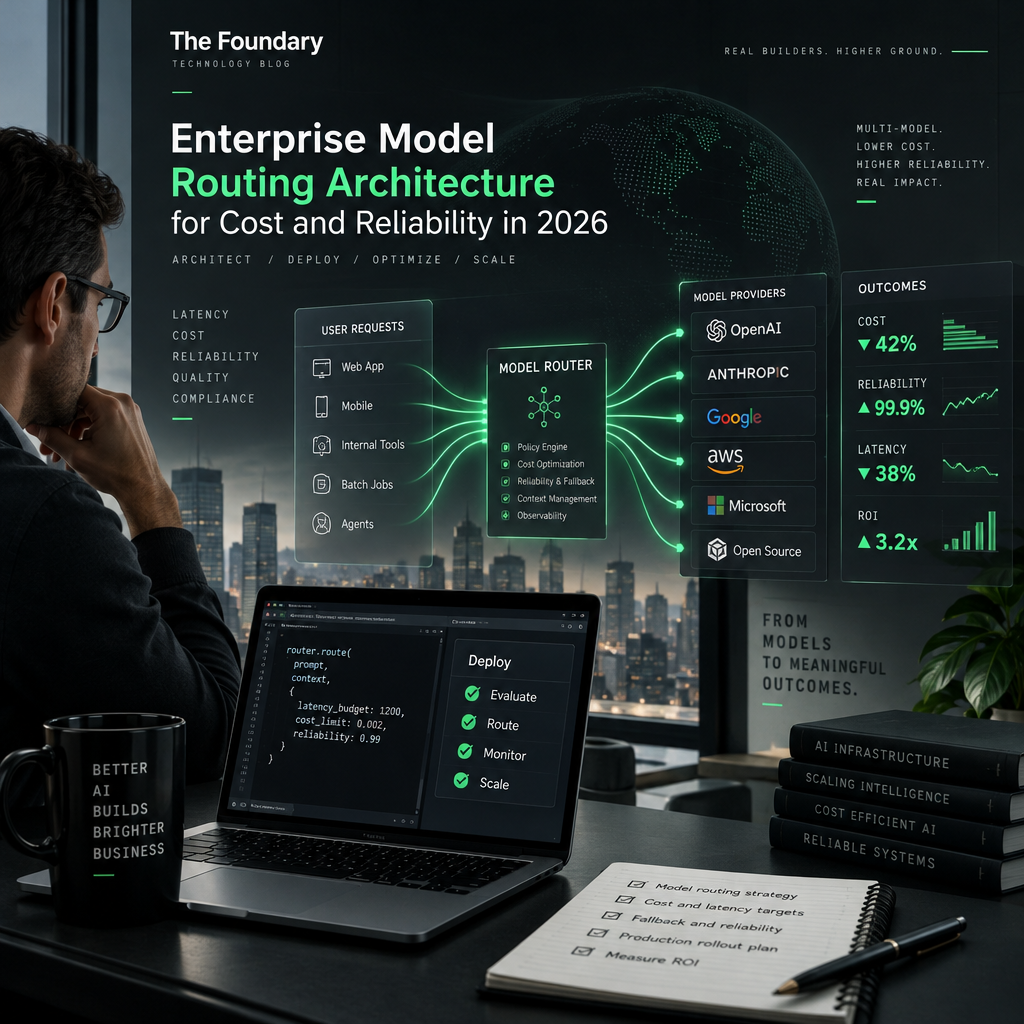
As of September 2026, your enterprise model routing architecture determines whether you succeed or fail at scale. Thirty seven percent of enterprises now run five or more models in production, up from 29% in 2025. This shift requires a new architectural pattern for balancing cost, latency, and availability across providers.
The Current State of AI Routing
You need to understand the scale before you begin. Model routing has become the core architectural pattern for modern AI platforms. Most teams run multiple models to avoid vendor lock in. They also use different models for different tasks. Some tasks need speed. Others need accuracy. This diversity increases complexity.
Recent data shows significant changes in adoption. Thirty seven percent of enterprises run five or more models in production, up from 29% in 2025 according to an a16z survey cited in getmaxim.ai on September 18 2026. This number is still growing. Your architecture must handle this growth without breaking your budget. Many teams struggle with hidden costs. These costs come from failed requests and inefficient routing. You should address these early.
Designing Your Enterprise Model Routing Architecture
Your foundation must be solid to support future needs. You will need to decide on deployment types early. Self hosted solutions offer control. Managed services offer speed. Hybrid approaches exist for specific needs. Each choice impacts your operational overhead.
Self hosted options like Bifrost provide control. They expose 25 plus providers and 10,000 plus models through a single OpenAI-compatible API according to getmaxim.ai on September 16 2026. You can host them in your VPC. This helps with compliance. Managed services like Cloudflare offer free core features including caching. They simplify initial setup. You trade control for ease of use.
The routing logic itself matters. You can use rule based systems. You can use learned systems. Rule based are easier to debug. Learned systems adapt faster to data. Kong AI Gateway provides seven balancer algorithms including semantic routing according to getmaxim.ai on September 16 2026. This allows fine control over how requests are distributed. Choose based on your team skills.
Selecting Tools and Gateways
The tools you choose impact long term costs. Overhead varies significantly between platforms. Bifrost adds 11 microseconds of overhead per request at 5,000 requests per second with 100% success rate in sustained benchmarks according to getmaxim.ai on September 18 2026. LiteLLM adds 8 to 15 milliseconds of overhead per request under typical load according to dev.to on September 17 2026. These numbers look small but they matter at scale.
Portkey Production tier starts at $49/month for 100,000 requests, then $9 per additional 100,000 requests according to omidsaffari.com on September 17 2026. OpenRouter charges 5.5% platform fee on credits or 5% BYOK fee above $25,000/month according to cadenya.com on October 8 2026. These fees add up quickly on large volumes. Compare total cost of ownership not just base fees. You may find managed services cheaper initially but expensive later.
Integration capabilities are also critical. All major gateways expose OpenAI-compatible endpoints for drop-in SDK migration. This allows you to test without rewriting code. You can connect existing clients directly. Anthropic Messages API compatibility requires gateway support. Bifrost supports Model Context Protocol (MCP) natively with Code Mode that can reduce input tokens by 58 to 93% according to getmaxim.ai on October 8 2026. Use this feature if you have high volume prompts.
Cost Optimization Techniques
Reducing spend is often the primary goal. Semantic caching can reduce AI inference costs by 50 to 95% for applications with repeated or similar queries according to getmaxim.ai on October 8 2026. This works best for chat applications with common questions. It does not work well for unique tasks. You must implement the cache correctly.
RouteLLM achieves up to 85% cost reduction while maintaining 95% of GPT-4 quality on MT Bench benchmarks according to dev.to/LMSYS on September 17 2026. This is a massive efficiency gain. It works by routing to cheaper models when possible. You need quality benchmarks to verify this. Run tests before full rollout. Ensure your quality metrics match business requirements. You cannot sacrifice user experience for cost.
Vercel AI Gateway offers a free tier including $5/month AI Gateway credits with current GPT-5.6 Sol 50% discount through September 18, 2026 according to omidsaffari.com on September 17 2026. This is useful for small pilots. It lets you test without upfront costs. For larger volumes you need to calculate the fees. OpenAI reduced API usage tiers from five to three on October 9, 2026. Monitor your usage tiers to avoid surprise billing. Budgeting is key to sustainability.
Managing Latency and Reliability
Speed and uptime are non-negotiable features. Cloudflare AI Gateway offers free core features including caching, rate limiting, and analytics according to dev.to on September 24 2026. It operates at the edge. This reduces latency for global users. However it adds latency for local users due to routing. You must measure real-world latency. Not all users are equal.
Amazon Bedrock Intelligent Prompt Routing routes only between two foundation models within the same family according to getmaxim.ai on September 16 2026. This limits flexibility. It is best for internal tools. For external products you need more options. You must define failure modes. If one provider fails how do you recover? Fallback chains are necessary.
Bifrost supports Model Context Protocol (MCP) natively with Code Mode that can reduce input tokens by 58 to 93% according to getmaxim.ai on October 8 2026. This also helps latency by reducing payload size. Monitor your upstream latency. Providers vary by region. You should have regional fallbacks. Test failure scenarios regularly. You need to know how long recovery takes.
Implementation Roadmap
Follow these steps to deploy safely. You should not rush to production. Safety is better than speed in this phase. Use a phased approach to manage risk.
- Week 1 to 2: Assessment. Inventory current models and providers. Calculate baseline token spend. Select routing strategy based on your needs. Choose deployment based on your team skills.
- Week 3 to 4: Pilot. Deploy gateway in non-production environment. Configure virtual keys with provider allowlists. Enable semantic caching for repetitive queries.
- Week 5 to 6: Migration. Change application base URL to gateway endpoint. Configure fallback chains for resilience. Set up budget alerts at 75% and 90% of monthly allocation.
- Week 7 to 8: Production. Enable adaptive load balancing. Connect to observability stack. Document and test failure scenarios for disaster recovery.
This timeline ensures you have visibility at each step. You will see cost impacts before going live. You will see latency impacts too. You can adjust rules based on real data. Do not skip the pilot phase. You need that buffer to fix errors.
Compliance and Audit Trails
You must meet regulatory requirements. Self-hosted options like Bifrost support VPC and air-gapped deployment. Cloudflare and OpenRouter are managed services without self-hosted options. You need to decide based on data residency. Bifrost provides signed audit logs with S3/GCS export. This helps with SOC 2 audits. You need to know what data flows where.
Check your vendor contracts carefully. Some providers have data residency clauses. Others do not. You need written confirmation. Review the terms on our blog for further guidance at https://foundary.xyz/terms-of-use. This ensures you stay compliant with internal policies. Audit logging is mandatory for enterprise. Keep your data secure. Monitor access patterns closely. You cannot ignore compliance costs.
For privacy requirements review our policy at https://foundary.xyz/privacy. This outlines how we handle data in our own systems. It serves as a reference for your needs. You might need to implement similar controls. Self hosted gives you more control over logs. Managed gives you less but saves time. Weigh this tradeoff carefully.
Conclusion and Next Steps
Your routing decisions determine success. You must balance cost with performance carefully. Keep your metrics tight. Review your costs monthly. Adjust your rules as needed. The field changes fast. You must stay updated on new features. You can build resilient systems. You can control costs effectively. It starts with the right architecture.
Talk to a Foundry engineer
Contact us to start a conversation with The Foundary about your build. Talk to The Foundary about your build
Conclusion
Your routing decisions determine success. You must balance cost with performance carefully. Keep your metrics tight. Review your costs monthly. Adjust your rules as needed. The field changes fast. You must stay updated on new features. You can build resilient systems. You can control costs effectively. It starts with the right architecture.
Frequently Asked Questions!
1. How do I handle multi-turn session persistence across providers without losing KV cache?
Self-hosted gateways like Bifrost or LiteLLM allow you to manage session state externally. You store session data in your database. The gateway forwards context without managing state itself.
2. What routing rules work best for cost-sensitive versus latency-sensitive workloads?
For cost-sensitive workloads use semantic caching and cheaper models for repetitive queries. For latency-sensitive workloads use low-overhead providers like Bifrost with direct routing to the fastest endpoint.
3. How do I test fallback chains before production deployment?
Deploy the gateway in a non-production environment. Use tools to simulate upstream failures. Verify that requests route to secondary providers within your defined SLA.
4. Can routing gateways handle both OpenAI Chat Completions and Anthropic Messages API?
Yes gateways like Bifrost and Kong AI Gateway offer Anthropic Messages API compatibility. You configure the provider mappings within the gateway dashboard.
5. What audit and compliance features are required for SOC 2 or HIPAA environments?
You need signed audit logs with export capabilities and VPC isolation. Self-hosted options typically support these better than managed services without data residency clauses.
6. How do I monitor gateway performance when upstream providers have variable latency?
Connect the gateway to observability stacks like Prometheus. Use real-user monitoring to track response times across different providers and regions.
By the Foundry Engineering Team · Updated 2026-10-13